
By Carlos Martin Schwab

Alexandr Misko – photo credit: Lukas Bezel
In his mid-twenties, Alexandr Misko has achieved what few working guitarists dare to imagine: dismantling the physical architecture of the acoustic guitar until it ceases to function—or sound—like one.
Far from settling within traditional acoustic boundaries, the Russian musician, currently based in Germany, has transformed his instrument into an analog workstation that challenges conventional luthiery, stage routing, and auditory perception.
In this candid, deeply technical conversation, Misko breaks down the mechanical engineering behind his infamous “Frankenstein” guitar, his rejection of fingerstyle purism, the exact signal chain powering his live and studio work, and his unfiltered perspective on the modern guitar community.
******
Carlos Martin Schwab: You started playing classical guitar at twelve, yet your current approach sits at the exact opposite end of the spectrum. How did that transition happen, and what was the true hook that locked you into the instrument?
Alexandr Misko: I actually started playing classical guitar through a complete paradox: I loved hip hop, and my parents decided to gift me a musical instrument thinking it would channel my interest, even though a microphone or a drum machine would have made far more sense.
I studied classical repertoire with a private teacher for three years, practicing one or two hours a day out of pure consistency rather than genuine passion, taking advantage of having endless free time after school. The real hook arrived when I started learning early-2000s alternative rock and nu-metal riffs—bands like Red Hot Chili Peppers, Puddle of Mudd, Nickelback, Korn, Limp Bizkit, and Linkin Park—hunting down chords and tablatures online because I had no musicians in my school class to form a band with.

Alexandr Misko – photo credit: The Achromat
The decisive turning point came courtesy of a pirated compilation CD my uncle brought me in Russia—the kind of unofficial disc with cover art that packed ten or twelve albums onto a single MP3 CD—which mixed modern classical guitarists with a track by Don Ross called Afraid to Dance.
Hearing that funky, percussive sound on an MP3 without being able to see how it was executed blew my mind, so I tracked Don Ross down on YouTube and through him discovered the entire second generation of CandyRat Records—Andy McKee, Antoine Dufour, Jon Gomm—alongside older Windham Hill pioneers like Alex de Grassi and William Ackerman, and ultimately Michael Hedges.
Because I already possessed three years of classical fundamentals in posture, fretting, and disciplined practice, I bought their tablatures and spent the next four or five years obsessively learning dozens of their songs and writing my own, eventually abandoning classical repertoire entirely while my teacher kindly helped me police my timing, intonation, and sloppiness on those new fingerstyle arrangements.
Carlos: What instruments were you playing during those formative years, and how did you make the leap to steel strings and heavily downtuned setups?
Alexandr Misko: My earliest YouTube videos were recorded on a very cheap right-handed Hohner classical guitar whose strings we simply flipped so I could play left-handed, and by some miracle of its simple construction it held intonation while I attempted harmonics and percussive tapping on a wide nylon fretboard.
I resisted switching to a steel-string acoustic out of fear that a narrow neck would feel uncomfortable, so I found a classical luthier in my hometown who built me a hybrid for around three or four hundred euros: a classical body shape and short twelve-fret scale length paired with a massive, baseball-bat-thick neck—so heavy it did not even require a truss rod—strung with steel strings.
For years I was never overly nerdy about string gauges or brands; I cycled through Elixir, D’Addario, and Ernie Ball until settling on a standard heavy .013–.056 set off the shelf that I have relied on for the past decade. As I began learning compositions by Jon Gomm and Preston Reed, who dropped their sixth string all the way down to A-sharp or G-sharp, and experimenting with mid-song retuning inspired by Adrian Legg, I realized that with .013s and my mechanical tuning systems, my highest viable tuning had to sit one full step below standard (D-G-C-F-A-D), and preferably two full steps down, to keep string tension manageable and prevent snapping strings onstage.
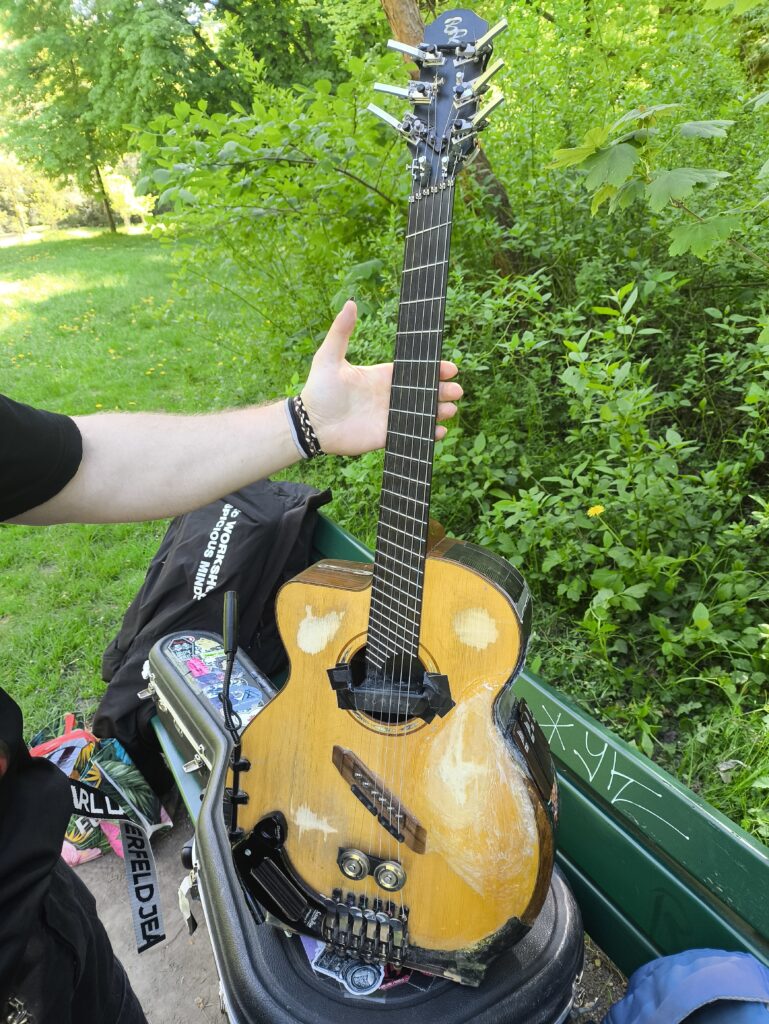
Photo credit: Carlos Martin Schwab
Carlos: Drawing a parallel between your musical evolution and the birth of your “Frankenstein” guitar, at what point did a standard acoustic cease to be enough?
Alexandr Misko: Across my first three solo albums, my drive was purely technical: I wanted to cram melody, bass, kick, and snare into a single performance, executing natural harmonics while simultaneously striking the soundboard—an approach inspired by Tommy Emmanuel’s one-man-band philosophy that was brutally difficult to play yet still sounded like a sophisticated acoustic guitar.
The need to physically modify the hardware emerged around 2016 from two realizations: first, I wanted to retune on the fly like Adrian Legg and Jon Gomm, so I installed banjo tuners—starting with two on the top strings and quickly expanding to all six; second, I watched a fingerstyle duo in Saint Petersburg performing standing up without external microphones thanks to a multi-pickup system, which freed them to move across the stage.
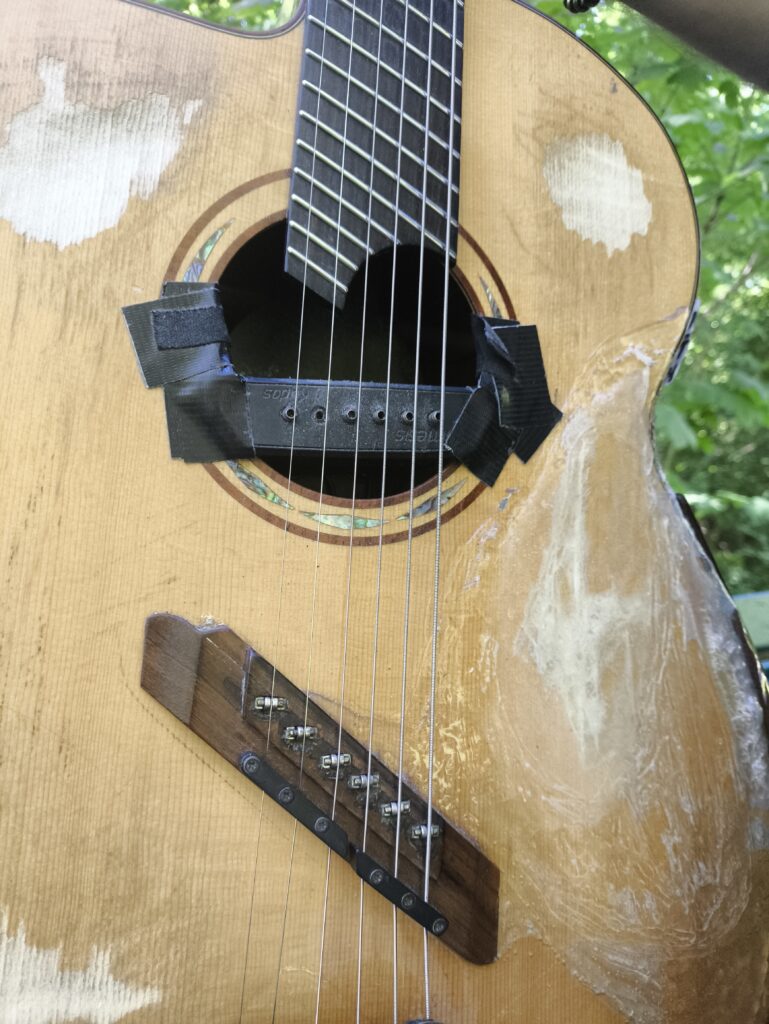
Photo credit: Carlos Martin Schwab
In 2017, the German brand Baton Rouge—which had launched a smart initiative sending guitars to young YouTube players—sent me one of their top models, the instrument featured on my viral Careless Whisper video and my second album Beyond the Best, and funded a three-pickup setup consisting of a magnetic sound hole pickup, a kick sensor, and an internal microphone.
However, once I started touring internationally and played the inaugural Guitar Summit in 2017, I noticed that the resonant thin tops and flexible necks of those guitars warped under my constant tuning changes, forcing me to waste minutes readjusting between songs.
That led me to commission George Lowden for a custom take on Jon Gomm’s signature model—featuring a cedar-spruce double top, a rock-solid four-piece neck, fanned frets for visual character and tuning stability, and six banjo tuners—which became my touring workhorse for three or four years and allowed me to expand my electronics to six discrete outputs, including stereo-panned side pickups on the left and right bouts to capture body scratches according to their physical geography on the instrument.
Carlos: After releasing Roundtrip in 2019 and hitting the pandemic lockdown, you experienced a severe creative block. How did that crisis spark the radical transformation of your instrument?
Alexandr Misko: During COVID, when touring ground to a halt, I felt I had completely exhausted every sound a wooden acoustic guitar could produce; it was not that I had mastered every genre, but rather that any traditional style—flamenco, jazz, metal, or classical—still inevitably sounded like a guitar, and that predictability bored me to the point where I wanted to quit composing altogether.
Collaborations saved my musical life: I recorded the progressive rock album Take Your Time as a duo with electric bassist Dmitry Choporov—a technical, Victor Wooten-inspired fingerstyle and slap player—writing everything from scratch in the same room so our parts interlocked like a giant ten-string instrument, and I revived an acoustic trio with a folk singer and a handpan player, which taught me how to leave space, relinquish melody duties, and enjoy the groove without carrying every musical burden myself.
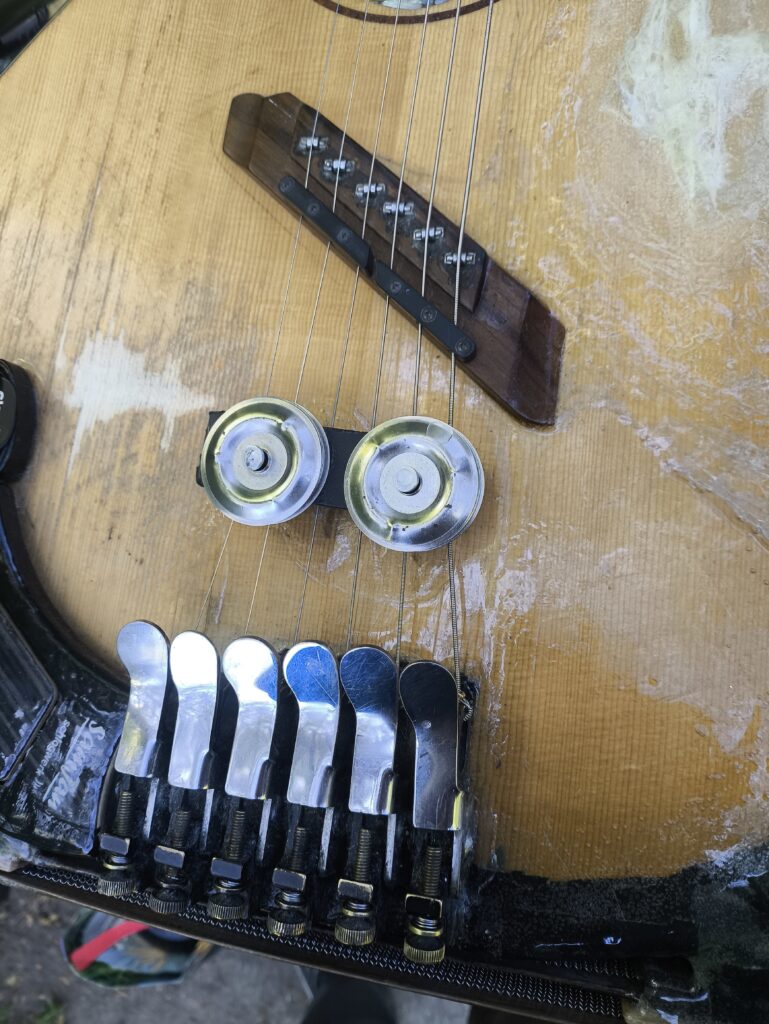
Photo credit: Carlos Martin Schwab
In 2021, Baton Rouge reached back out with a no-lose proposition: funding my no-compromise dream guitar alongside Munich luthier Stefan Zirnbauer of Munich Guitar Company. To maximize structural rigidity against extreme tension shifts, we reinforced both the neck and the body with carbon-fiber tubes and mounted a twenty-year-old discontinued Hipshot detuning bridge onto a custom wooden block added to the lower bout.
Unlike Michael Manring’s Hyperbass bridge, which shifts strings in groups or all together, this Hipshot mechanism gives me independent lever control over every single string, though even after that project spawned a more conventional fanned-fret signature model in 2023, I still felt I needed one final breakthrough to unlock new compositions.

Carlos: What was the final breakthrough that turned that prototype into the steampunk machine heard on your latest album, Final Boss?
Alexandr Misko:The breakthrough arrived in 2023 amidst a turbulent personal chapter of fleeing the war, bouncing between Turkey, Georgia, and Germany due to visa restrictions, and preparing to permanently relocate.
Online, I stumbled across Timara String Drops, invented by American builder Tim Wallace—small headstock-mounted levers that press down on a string behind the nut to drop its pitch by a preset interval instantly.
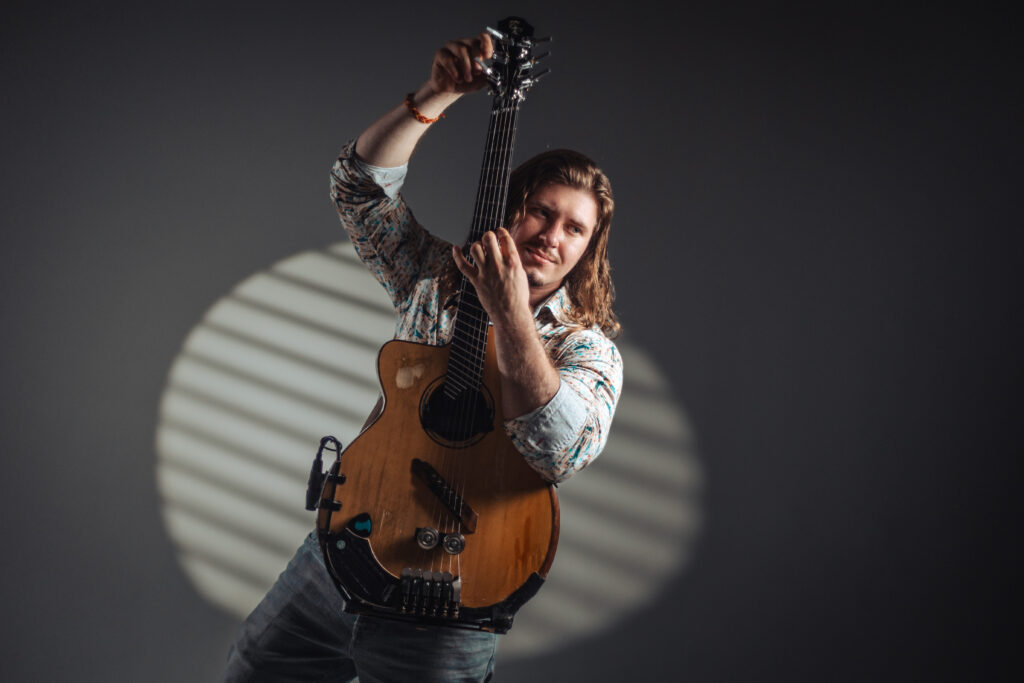
By mounting six String Drops directly above my six banjo tuners and pairing them with the six Hipshot bridge levers, I created a triple detuning system with eighteen mechanical levers in total: I can generate four distinct pitches per string without fretting a single note, playing entire scales off a single natural harmonic.
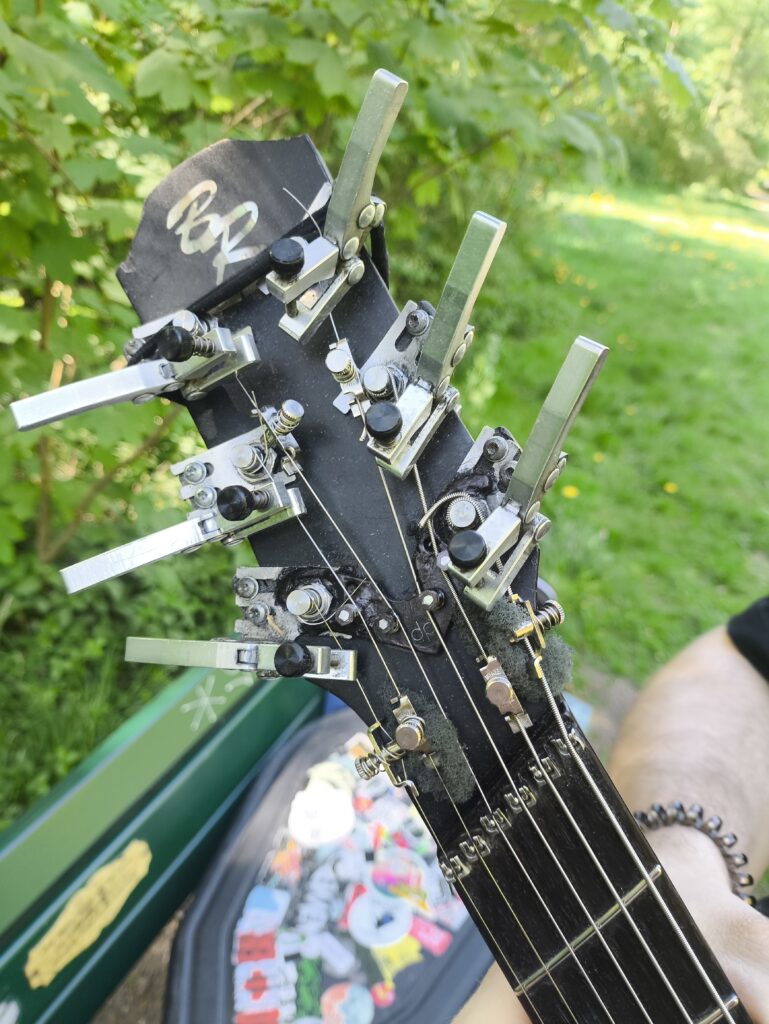
Photo credit: Carlos Martin Schwab
Around the same time, I remembered the SamJam by German percussion maker Schlagwerk—a wooden platform containing internal snare wires invented with Turkish musician Sami Cinar—and paired it with a longer Schlagwerk accessory called the Frame Buzz glued onto the upper bout. That birthed my “Drum System 3000”: the SamJam acts as a crisp metallic hi-hat while the Frame Buzz functions as a real snare, replacing hollow wood thumps with realistic, hip-hop-inflected metallic textures that are entirely acoustic and free of loops or MIDI triggers.
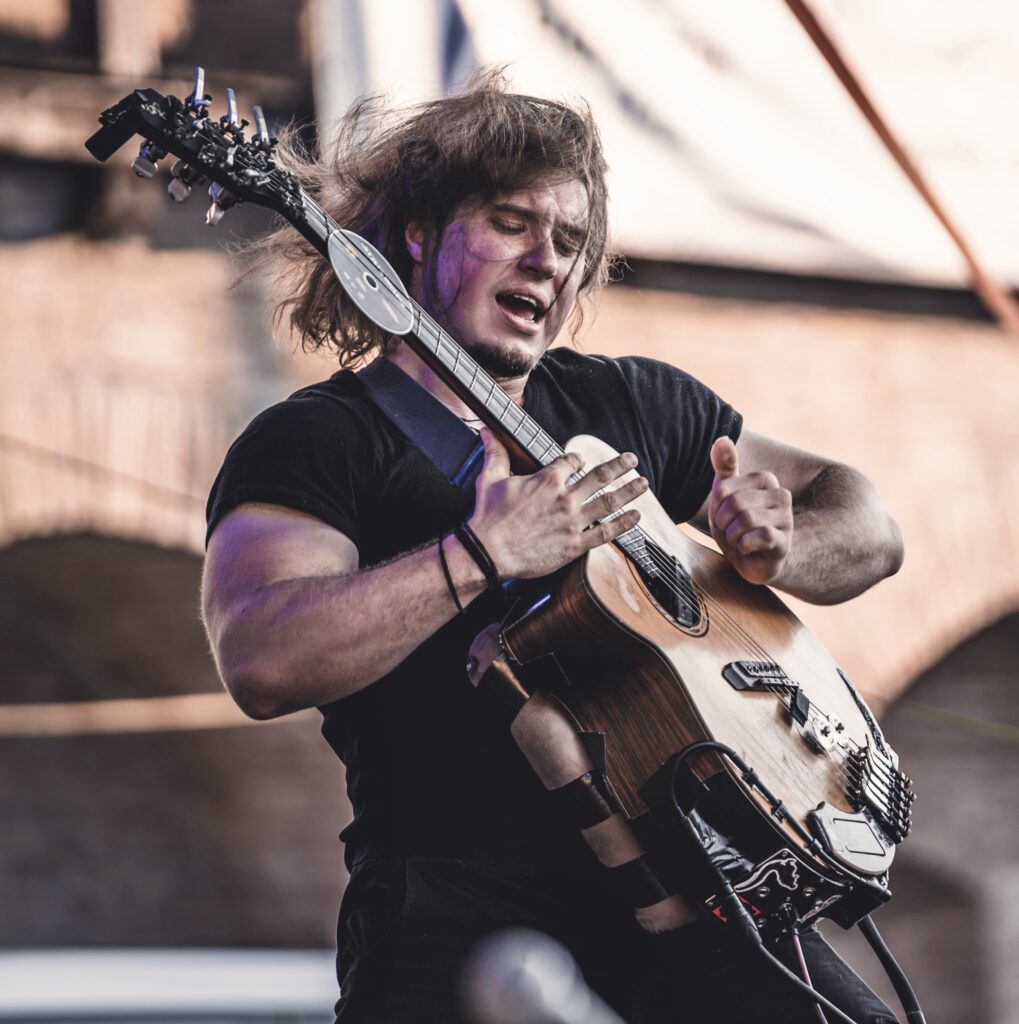
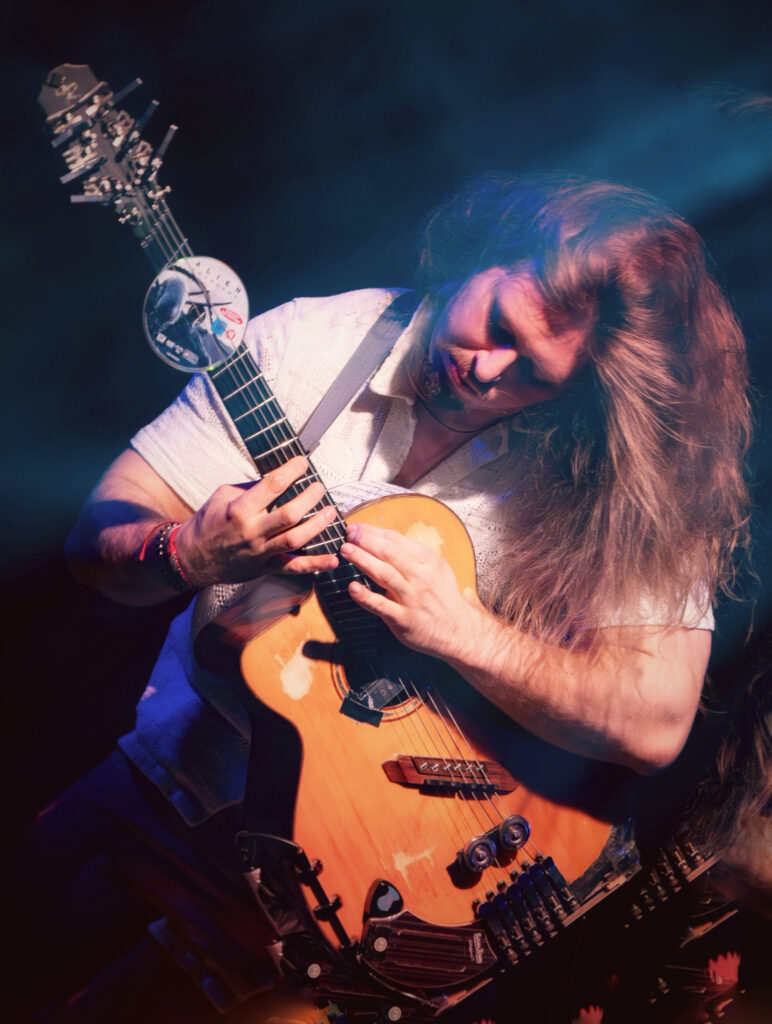
Inspiration flooded back immediately, yielding tracks like Umbrella Street—which contrasts standard palm-muted picking with lever-bent harmonics—and Intergalactic March, where I weave a DVD between the strings to eliminate open strings and harmonics entirely, forcing myself to fret every note against wildly uneven string action.
Carlos: From a luthiery and live-sound engineering standpoint, how does the guitar survive this physical punishment, and how do you route seven analog signals to front-of-house without turning stage setup into a nightmare?
This original Frankenstein is literally battered with deep scratches and holes worn straight through the soundboard, and while it should survive the hundred shows left on my calendar this year, Stefan Zirnbauer is already building a second version where all eighteen levers, carbon reinforcements, and percussion modules are integrated cleanly from the factory without glue or tape.
Alexandr Misko – photo credit: Harmonia Cordis
The most liberating realization of this journey was accepting that the guitar no longer needs to sound good unplugged; all the metal hardware glued to the top has killed its acoustic resonance down to the volume of a semi-hollow electric, so for the new build we are using a much thicker, acoustically inert top to maximize tuning stability.
I have also ruled out True Temperament frets because their curved geometry only works for one fixed tuning and would fight my constant pitch shifts. To eliminate the thick six-cable analog snake Klotz originally built for me, we engineered an analog routing system that sends six discrete signals through a single CAT 6 Ethernet cable into a splitter box—meaning if a cable breaks on tour, I can buy a replacement at any computer shop—paired with one dedicated XLR cable for the external microphone glued to the side to capture the snare rattle.
Carlos: When you bend a natural harmonic using your levers, the sustain is remarkably long and crystalline with zero muddiness. How is your live signal chain structured to achieve that clarity?
Alexandr Misko: That sustain does not come from extreme compression—in fact, I need dynamic headroom to balance strumming, tapping, and harmonics—but rather from attacking the harmonic firmly and making my magnetic pickup the dominant voice in the mix.
I use a handmade pickup built in Scotland by the late luthier Mike Vanden—the original inventor of the Fishman Rare Earth Blend—which offers a fatter, richer tone than the mass-produced version and features individually adjustable pole pieces so I can balance string-to-string output. On my pedalboard, only the magnetic signal runs through traditional electric guitar effects like a Whammy, a Boss OC-5 octaver for bass lines, and distortions, keeping the body percussion completely unaffected.
Alexandr Misko – photo credit: Mantis Photography
All ten resulting lines—including dry and wet pedal splits—feed into my portable QSC TouchMix 8 digital mixer, where I process each transducer like an individual band member with dedicated EQ, noise gates, and compression; from there, a stereo master runs through my Strymon reverbs, delays, looper, and a custom stereo mute pedal so the house engineer only has to pan two channels. During soundcheck, I record a loop, walk out into the hall alongside the engineer to dial in the room EQ from the audience’s perspective, and finish the entire setup in twenty minutes.
Carlos: Your studio workflow reverses the traditional cycle of recording an album and then touring behind it. How did you approach production to capture the massive scale of Final Boss, and what role does the album format even play in today’s single-driven music economy?
Alexandr Misko: For short social media clips, I simply record the stereo output of my live pedalboard straight into an audio interface on a train or in a hotel room, knowing people will listen on their phones, and technically speaking, full-length albums are almost obsolete today because most listeners consume playlists rather than front-to-back concepts—meaning an independent artist could easily sustain a career by releasing one single every month and pressing a tour EP just to have merchandise to sell at shows.
Still, I treat a full album as a personal milestone and celebration to measure major creative chapters, so for Final Boss I spent two years road-testing the songs live to lock in exact tempos and subjected every arrangement to ruthless structural critiques from trusted friends like classical harpist Alexander Boldachev and bassist Dmitry Choporov, trimming lengthy bridges and swapping verses with choruses until zero filler remained.
After tracking thirteen dry channels per song in Germany, I flew to Finland to mix at Mimix Studio with Juri Seriola, spending twelve hours a day for a solid month dissecting every bar: overdubbing single notes to simulate panned reverb tails, re-recording specific string buzzes, and even submerging a plastic-wrapped microphone in a bowl of water to capture organic splash textures.
We obsessively checked every mix on a smartphone speaker to ensure the percussion retained its punch across playback systems, stopping only because my upcoming US tour imposed a hard deadline—reminding me that as an independent artist, you have to stop at ninety-five percent perfection before you lose objectivity and ruin the record.
Carlos: Looking at the broader modern guitar landscape, where viral innovators like Marcin and Tim Henson coexist with acoustic traditionalists, how do you view the health of the community?
Alexandr Misko: We are living through an exciting era with an extraordinary diversity of styles—from Michael Hedges opening the door forty years ago to modern pioneers like Eric Mongrain, Preston Reed, Luca Stricagnoli, Marcin, and Matteo Mancuso—yet the guitar community remains plagued by toxicity, jealousy, and keyboard warriors who click on genres they dislike just to dismiss them as “soulless”.
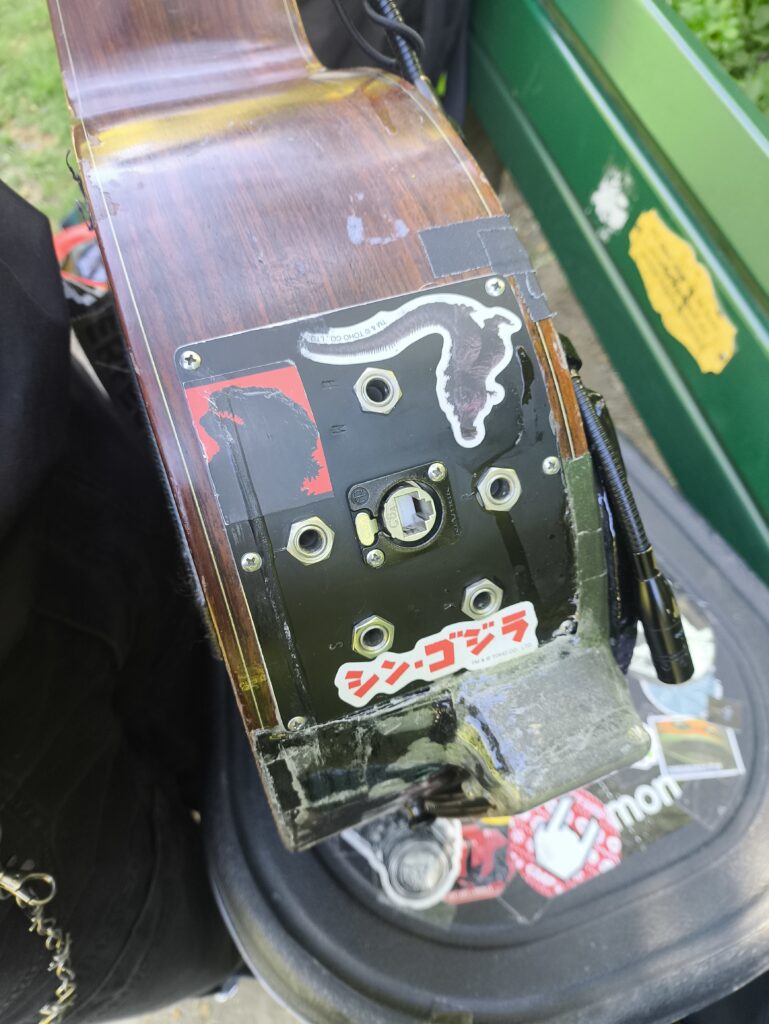
Photo credit: Carlos Martin Schwab
While I defend friends like Marcin whose live chops are undeniable, fake or heavily manipulated social media performances—like the controversies surrounding Giacomo Turra—genuinely hurt young learners by setting impossible standards. It also saddens me that acoustic fingerstyle remains such a homogeneous club of middle-aged white men, though I am thrilled to see a younger generation building their own DIY Frankenstein guitars and entering my riff competitions.
Unlike thumbpickers in the Chet Atkins or Tommy Emmanuel tradition, modern percussive players rarely jam together backstage at festivals—partly because our arrangements rely on intricate choreography rather than improvisation, which I neither practice nor enjoy, and partly because we would rather catch up and talk. Even though Tommy Emmanuel is not a fan of our percussive style, I deeply admire his relentless work ethic, business acumen, and stage energy at seventy years old, while Jon Gomm remains my true “spiritual vector” for his musical honesty and philosophy.
Alexandr Misko – photo credit: Lucas Media Corner
Carlos: To wrap up with a practical reflection for working musicians: what advice would you give professional guitarists who spend endless hours obsessing over tonewoods, string gauges, or the latest digital modeler?
Alexandr Misko: Honestly, talking about tonewoods, cables, string gauges, or whether I use Strymon pedals versus a Quad Cortex is my least favorite topic on earth. When you step onstage and play sloppy or out of time, nobody in the audience cares whether your back and sides are rosewood, whether you play .013s, or what reverb algorithm you chose—just as nobody cares about virtuosity for its own sake when a great song by Kurt Cobain or a raw punk band moves a room through melody and vibe.
There is a dangerous inverse correlation in our industry: the more a guitarist knows about wood combinations and gear specs, the fewer hours they usually spend practicing and composing. Pedals, pickups, and radical hardware modifications should never become an end in themselves or an excuse to hoard equipment; they are strictly tools meant to help you find your own voice and write music that genuinely resonates with another human being.
More info at https://alexandrmisko.com
BONUS VIDEO – ALEXANDR MISKO’S “MASTER CLASS”