By: Steve Canfield

Photo credit: Tatyana Makariva
PART 1 covered syllable stress. PART 2 zooms out. The shape of a melodic line does as much emotional work as the words do.
In PART 1 we looked at syllable stress: how individual words carry natural emphasis patterns and how the melody either supports or fights those patterns. PART 2 zooms out one level. Beyond the word there’s the phrase, and beyond the phrase’s stresses there’s its shape.
The three phrase shapes!
Every melodic phrase has a contour. Most phrases fall into three basic shapes.
Rising. The phrase ends higher than it began. “I’ll see you to-MOR-row” on a rising line carries forward motion, a question, hope.
Falling. The phrase ends lower than it began. “We used to dance all NIGHT” on a falling line carries settling, arrival, resignation.
Arched. The phrase rises, peaks in the middle, and falls back home. “So I called her on the phone” with the peak on “called” and a descent through “on the phone.” Most natural speech sits here. The arch is the default shape for a statement of fact.
The interesting work happens when the contour of the line matches, or deliberately fights, the emotional content of the words.
Descending lines sell loss!
This might be the single most useful observation in the whole prosody toolkit. If your lyric is about loss, disappointment, resignation, or quiet grief, a descending melodic line will do half the emotional work for you. The words don’t have to strain. The contour does the selling.
Think of Leonard Cohen’s “Hallelujah.” The word itself is set to a four-note descending line in the chorus. The descent is mournful before the listener has even processed what the word means. Now imagine the same word set to an ascending melody. It becomes celebratory. Same word, opposite effect, entirely because of phrase contour.
When you’re writing a line about loss and it’s not landing, check the contour first. If your melody is arching or rising, the music is fighting the words. Try rewriting the phrase so it ends on the lowest note of the line. You’ll often find the lyric suddenly works without a single word changing.
E minor descending phrase (standard tuning):
e|–7—5—————|
B|———-8—7—5—|
G|———————-|
D|———————-|
A|———————-|
E|———————-|
Lyric: “She was gone by dawn”
Notes: B A G F# E
The final long vowel (“dawn”) lands on the lowest note. The descent does the emotional work before the listener has processed the line.
Ascending lines sell hope!
The inverse is true. If your lyric is about longing, possibility, pursuit, or unresolved yearning, an ascending line carries that forward motion. Ballads often save the ascent for the chorus payoff. The verses may arch or settle, and then the chorus lifts, suggesting the feeling of the song is still reaching for something.
A lyric that wants to feel aspirational but lives on a descending melody will always feel slightly resigned, no matter what the words say on the page. Flip the contour and the same words start to sell the hope they were trying to describe.
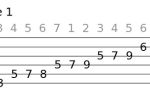
C major ascending phrase (standard tuning):
e|——-0—1—3—|
B|–1–3————-|
G|——————-|
D|——————-|
A|——————-|
E|——————-|
Lyric: “And one day we’ll fly”
Notes: C D E F G
The final long vowel (“fly”) lands on the highest note. The rise carries the forward motion the lyric is reaching for.
The arched phrase is a workhorse!
Most verse lines are arched, because most natural speech is arched. They rise into a peak and then resolve back home. Use arched phrases as your default. Save the explicit rising and falling contours for moments where the emotion of the lyric justifies the special treatment.
A common amateur mistake is making every phrase the same shape. Verses all arched, or every line rising into the chorus. Vary it. The contrast between a rising line and a falling line is one of the strongest expressive tools you have, and it costs you nothing but attention.
Vowels want length!
Prosody isn’t only about emphasis. It’s also about the vowels themselves. Long vowels (the “I” in “mine,” the “o” in “alone”) want longer notes. Short vowels (the “i” in “sit,” the “u” in “cup”) want shorter notes. Match the duration of the note to the natural duration of the vowel and the line sings smoothly. Pit a long vowel against a sixteenth note and the singer has to rush the syllable to fit, which sounds stilted regardless of the pitch choices.
This is one reason country and folk lyrics often end phrases on words like “moon,” “rain,” “alone,” “gone.” Those are long-vowel words that sustain naturally on whole notes. The instinct of a good lyricist is to pick words whose vowels want to ring out where the melody asks them to ring out.
A ten-minute rewriting exercise!
Pull up any song of yours that isn’t quite landing. For every line, mark the contour: rising, falling, or arched. Now ask yourself a single question: does the contour match the emotional content of the line?
– If the line is about loss and arches upward, you’ve found a rewrite target.
– If the line is about hope and falls downward, you’ve found a rewrite target.
– If every line in the verse has the same shape, the verse will feel monotone and you can break it up by changing the shape of one middle line.
You don’t have to change the words. You often just need to change the shape of the melody.
Putting it together!
Prosody is a discipline of listening. Strong syllables want the strong beats. Long vowels want long notes. The shape of the line wants to match the shape of the feeling. None of this is complicated, but all of it requires slowing down a little on the lyric side and letting the words guide the melody as much as the other way around.
The songwriters whose lyrics feel inevitable are almost always the ones who’ve internalized these habits until they don’t have to think about them. The rest of us can get there the slow way, one line at a time, one rewrite at a time.
Write with your hands on the guitar, by all means. But say the line before you sing it, and check the shape of the phrase against the shape of the feeling. Your songs will thank you for it.