By: Rick Landers
Images by: D.A. Peterson

Valeria Stewart has been making waves in the venues around the Washington, D.C. music scene for years. Although her local haunts are in the D.C. area, Valeria was born in Argentina and pays tribute to her roots with her new album presented in Spanish, and with a bevy of beautiful original and cover songs that highlight her mesmerizing vocals, as well as being grounded in the fine support from other local musicians.
Like many successful singer-songwriters, Valeria, has diligently worked her way performing at open mics, local venues, listening rooms and festivals. Her melodic and lyrical expressions have been recognized by winning 12 Mid-Atlantic Song Contest awards, for such tunes as, “El Dia Mas Oscuro,” (The Darkest Day), New Miner’s Blues,” “Our Days in Ordinary Time,” and more.
Other highlights of her career were songwriting awards, that include: being a 2021 winner in the John Lennon Songwriting Contest; a SemiFinalist International Songwriting awardee (2021) for “Ensueños” (Reveries). And in 2025 she received an Unsigned Only Semi-Finalist award for her song, “Eres Mi Amor” (You Are My Love).
Along with her passion for music, Valeria told us she’s able to find great balance in her “day job,” as a part-time pre-sch00l teacher at Kidstretch, a Falls Church, Virginia, preschool where she works supporting families in transitional housing.
“When I walk into work, I have to drop all pretenses, I am only there to serve the kids and support my coworkers. The phone and social media break, plus working for others is grounding.” – Valeria Stewart
Guitar International magazine is delighted to introduce Valeria and her beautiful music to our readers as her career takes off and her songs gain fans around the world,
******
Rick Landers: Let’s start out with your new release and your reasoning behind making it in Spanish. Was the decision based on cultural pride, or the world demographics to reach different audiences than typical here in the States?
 Valeria Stewart: It’s funny, I personally had no plan to go record an album or even an EP of all my Spanish material! I have been collaborating since COVID with my friend singer-songwriter Kevin Dudley, and we had recorded a bunch of material in my home studio, including some of the songs on the new album, to submit to the MASC (Mid Atlantic Songwriting Competition).
About a year ago, when we discussed going to record in a studio at some point, he suggested we prioritize work on a solo EP of all my best Latin songs. He’s been around the music world longer than me and his feeling was that the Latin genre and the songs themselves would really stand out, that is, reach a larger and different audience than some of the Americana style songs we’d collaborated on. Furthermore, I had been performing a handful of these songs in our combined music sets, with always positive praise from mostly American audiences, so it felt like a good next step.
Rick: Who are the players on the album and what did they bring to the table as far as their musical talents, and other strengths that helped make the project more enjoyable or challenging?
Valeria Stewart: The plan for the co-produced album, which started off as an EP until I added two cover songs, was to minimize recording studio time, and play and record the songs ‘live’ with a quartet of players that would be seasoned enough to rehearse a minimum of two live shows plus a home practice, plus work on their own.
The vocals are central to this solo project of course, and I play the rhythm guitar throughout the album. I am more accustomed to singing while playing, but have recorded separately, as well. For this record the plan was to ‘perform’ the way I usually do at shows, so simultaneously track vocals and guitar, with a minimum of tries to get things right, which is a challenge, but emits more of a live presence.
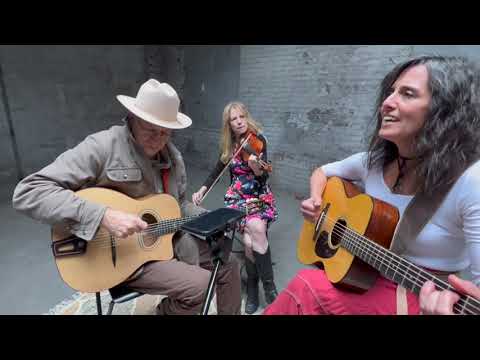
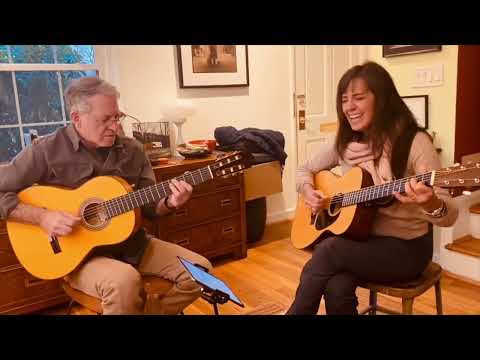
The lead guitar throughout the album was arranged and performed by Kevin Dudley, who’d been honing his classical guitar chops for a couple years and gave this whole record a distinct flavor which is not totally traditional. He’s a pretty versatile musician and blended a combination of flamenco, elements of blues, and samba rhythms on Raíces. Note his nod to Carlos Santana on the second interlude of Por Qué. I know by the end of the first day at Bias Studios (Springfield, Virginia), he was pretty worn out by the amount of intricate parts he had to perform! We aimed to getting all seven songs done in two days, and by day one had finished five, with a couple re-dos for day two.
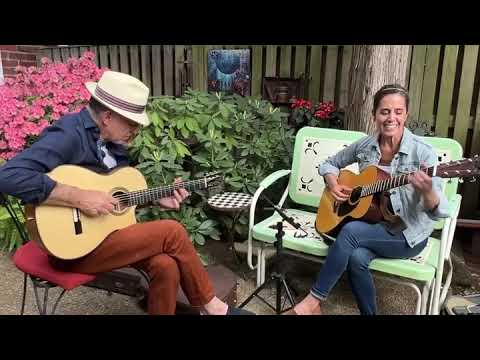
The double bass was important for the style of this album, which is primarily acoustic with strong Latin rhythms. I had recently been performing from time to time with a local jazz guitarist named Pat Mackin, and I asked him one day if he played with any stand up bassists, and whether they’d accompany me on my songs some time, so that’s where I found Eugenio Ibarz.
Eugenio is from Spain, and has been playing in local jazz duos and trios for years, so he had a combination of skills and cultural knowledge to be a great fit for my music. He is a very intuitive player and we immediately got out to perform at cafes nearby, and with Pat’s help, organized the charts for dozens of my songs, including the ones on the album to be. He was enthusiastic from the start and was my first choice for recording.

Percussion is super important to these songs, as well, and I hadn’t yet played or met a ‘Latin’ percussionist so, as it was time to plan our recording a few months out, I went back to my jazz colleagues’ social pages to filter through and YouTube searches for locals who seemed like a good fit.
That’s how I found Jason Walker. He happened to be in a couple videos related to Eugenio, and coincidentally works at the same private D.C. school as him, so that all seemed to be a good sign towards working together on pretty short notice! He came to our first rehearsal at home with every Latin percussion option that could fit in his car probably.
My favorites, of course, are the conga drums and bongos on the record. That combined with Eugenio’s bass make for some good dancing rhythms! Finally, on the last song, the Argentine “Zamba de Usted”, we tried with a track of clave at first, but the only true Argentine drum for a zamba is the Bombo Ligüero, a large, traditional folk drum made from a hollowed-out tree trunk with a head made of cured animal skin. It’s a fundamental instrument in Argentine folklore, so at the last recording session at Bias a few weeks after the main recording, I brought in local Argentine percussionist, Juan Megna, a colleague of Eugenio’s in the world of local jazz players.
Rick: Do you come from a musical family or are you the artistic one in the family?
Valeria Stewart: My parents were always big music lovers. My mother sang and hummed along to radio songs, and dad, I discovered coming home from college, had an extensive vinyl collection, including American folk heroes Dylan, Baez, etcetera and also an eclectic jazz and classical mix I learned to love.
Dad knew a few basic guitar chords and would play some Argentine folk tunes during parties at home in Maryland. We grin at those memories because he couldn’t really sing in tune, but it never stopped him! My maternal grandmother was a good pianist, and performed in what were basically house concerts, sometimes with singers in her neighborhood of Buenos Aires. I began as more of a visual artist, and studied Graphic Design in college, but was never far from my guitar since about age 12.
Rick: I’d guess that most of your local audiences are English speaking and wonder how your new songs translate emotionally to them when they may not understand the lyrics?
Valeria Stewart: Surprisingly what I noticed in the last couple of years, was that American audience members’ reaction to my Latin songs was “I don’t know what words you’re singing, but the sound and quality of your voice in Spanish, and the music, is something very beautiful/unique, and I want to hear more”.
 No one specifically asked for a translation, but I decided to start bringing little handout sheets to shows, like a program, with song titles and descriptions, not word by word translations which is very hard to do. Friends and audience members had a very positive reaction to that, so I’ve used them for many shows since, and provide the download on my website under the “MUSIC” menu.
Rick: What have been some of the most challenging times you’ve had being creative or inventive, learning the business side of music, or figuring out the technical aspects of recording your music?
Valeria Stewart: The creative and inventive phase, even when I’m not songwriting, goes on through it all, but I have to say while releasing a new record, writing is definitely on hold. For me the techie stuff is not easy but I’d say I enjoy that kind of work. Since I started using GarageBand at my home studio, doing lots of demos with Kevin, submitting to all kinds of song contests etcetera, its been a great skill to learn.
As for the business side of it, I have a Bachelors of Fine Arts (BFA) in Graphic Design and I can’t think of a better space to use those skills now as I promote myself continuously; videos, posters, social media reels and posts, using photography and typography. The other side of music business, album and single releases, radio promotion, constant blowing your horn, I find pretty exhausting and on a good day, exhilarating.
CHECK OUT VALERIA STEWART’S YOUTUBE CHANNEL!
Rick: It can be tough to break into new territories beyond our local music communities. Have you developed some kind of strategic plan to grow your fan base outside the Washington, D.C., area?
Valeria Stewart: I have been fortunate to have a great power couple mentoring me – Lynn Veronneau and Ken Avis, who’s Antidote label I was invited to publish under for this album. They have been paving the way for me to get out to more audiences beyond where I’ve been performing. They were instrumental in me signing up for a world music radio promotion via Kari-On Productions, with among other goals, the hope that it will provide a wider audience and the potential to move my shows outside the D.C. Virginia areas. I don’t have a strategic plan in place other than to keep playing and accepting as many offers as I can while keeping my part time assistant teacher job I so love.
Rick: What gear are you using when writing your originals, performing them or making them shine in the studio?
Valeria Stewart: I have gravitated to a couple simple tools – Voice memos always! To talk and record my thoughts while on walks, or write blurbs in one of my journals as they come straight out of my head. I sit for a half hour every day or so and just play guitar. It’s a stress release. I do some latest favorite cover, or polish up an old song if I’m not writing new material. To polish up a song, I use either a blue mic connected to my iPhone, to listen back to things I’m trying, or a condenser Ear Trumpet Delphina model I have plugged in and ready to use with a small wireless Bose S1 right in my office/studio.
That is my preferred practice technique, since it gets my ears into that amplified space, and ready for whatever type of performance. I often move voice memos or Blue mic recordings to GarageBand and EQ them a bit, to have good quality practice tracks to share with band members.
Rick: Singer-songwriters tend to steer toward certain types of guitars when it comes to their sizes, tone woods, or even favored brand names. What are your preferences? Do you use any pedals and what about amps?
Valeria Stewart: When Steve and I were first married, in 1992, I started playing guitar again after a hiatus. We went to a little shop in D.C. and bought a classical nylon-string Esteve from Spain. I used to show up with it at local CABOMA bluegrass jams—definitely an oddball choice for that scene. It was the only guitar in our house for years. It got pretty worn by the time I shared it with my teenage son, Matt, but by then I had my first Taylor: the BBT. It was beautiful—very bright—and it marked the start of a new phase.

Around our twentieth wedding anniversary, in 2011, we bought my Gibson Hummingbird. That was the first guitar I completely fell in love with. I even had nightmares about it being stolen at music festivals. I brought it everywhere. It has its share of dings from all the travel and gigs, but it still sounds gorgeous. It matched my voice really well—full, but not overpowering.
Once a year, we travel to southern France, where my father last lived before he passed. While he was alive—and even after—I’d bring a travel-size Taylor Mini along. It was perfect for flying: small enough to store easily onboard.
In 2023, I went to Nashville for the first time to attend the Americana Music Conference. While I was there, I wandered into Gruhn Guitars and ended up buying what’s now my favorite guitar: a small-body Martin 00-18. Just five months later, I had to undergo major corrective back surgery for a degenerative condition that had finally reached a breaking point.
During the long recovery, the only guitar I could physically manage; light enough, small enough to cradle against my sore body was that Martin. It became part of my healing. I’m 100 percent better now and still gig with it regularly.
About a year before I found the Martin, I’d also picked up a Cordoba, part of the Orchestra CE Fusion series. It reminded me of that old Esteve I started with, and it’s the guitar I used to record the Zamba on the Raices album.
I don’t use pedals, but I always bring my Fishman Platinum preamp for performing.
Rick:There are several types of venues and they all have different “feels,” like listening rooms (house concerts), bars, wineries, festivals and more. Do you have a favorite and what is it that gives you the best comfort level?
Valeria Stewart: I have had the chance to play at all of these types of venues and I’d say bars are my least favorite because of the obvious; I am not presenting loud bar or dance/party music, and prefer to have audiences who listen to and appreciate lyrics and the groove, which are important.
I had fun playing at a small winery in Markham, Virginia, called Naked Mountain Winery the last couple of years with my Crooked Sparrow trio, and festivals have always been a great experience. Some of the most intimate and meaningful connections I’ve felt with an audience have been during house concerts and, more recently, at the Creative Cauldron theatre. During a sold-out show in that 108-seat venue, I felt completely surrounded—by friends, family, and new followers. It was a truly special night, full of warmth and positive energy.
Rick: Being an “all rounder” musician demands not only having a creative talent, but also developing a stage presence, along with the mundane tasks involved in the business aspects of the job. What elements of being a working musicians have been the most challenging?
Valeria Stewart: Musically, I’m always preparing, practicing, listening. So, the most challenging has been learning to have a good stage presence, to be in the moment, and totally prepared and relaxed so that the audience comes along for the ride and relaxes too. It’s amazing how effective it is to smile out there at someone while you sing to them if you’re calm enough.
I’ve been an introvert that learned to be extroverted because I wanted to do this art form so badly. I found a method that works for me, just like in songwriting. That is, stay honest, authentic, and vulnerable.
I spend moments before big shows meditating, envisioning myself talking and telling my life stories in front of people, in my style, so I try it all out in my imagination, even using notes and a journal I brought with me on stage at the Cauldron, to keep grounded and read aloud words or stories that I didn’t want to screw up! And when you do mess up it brings you down to earth anyways, I think people appreciate vulnerability in the stage banter as long as when you’re performing you’re in the zone.
As far as mundane tasks involved in the business aspects of the music work, I work 20 hours a week max at my pre-k job for a reason, because it gives me two full weekdays to accomplish the mundane stuff needed for a DIY musician to maintain a presence on and off line, to pursue leads, booking inquiries, promo promo promo!
It feels like you hit a wall some days, but after a few years of getting better opportunities, venues do come back and they reschedule you for presenting good quality programs, being on time and organized, and for doing the ‘work’, promoting on all the channels etcetera.
Rick: I understand that you were born in Argentina. Have you had an opportunity to perform there or is that one of your dreams?
Valeria Stewart: I brought my travel guitar on my last trip there in 2024 and it had been like 11 years since my last visit. I signed up on line for an open mic in town, and just showed up to play late at night, with the house band. It was a lot of fun and more loud and electric than I’ve ever sounded, but I do think it would be even better to set up a few gigs before hand!
I made contact with a young pianist from Buenos Aires who had performed at Takoma’s School of Musical Traditions stage one night as part of a Tango presentation, and we messaged back and forth about setting something up last visit, but it was December, holiday time, lots of folks leaving town or venues already booked. So I need to get proactive before our next trip.,
Rick: Now that your roots album is released, do you have another group of songs in mind for your next album or single, and do you think you’ll venture into another style of music or working with musicians that may play unique instruments to add a different flavor to your work?
Valeria Stewart: As a matter of fact I’ve started recording a new batch of songs, both older and new, in collaboration with Leandro Alvarez, an Argentine producer based in L.A. We met by chance in May at a fundraiser in Potomac, Maryland, where I performed a few songs alongside him and legendary accordionist Chango Spasiuk.

Leandro expressed interest in producing an EP of my music for next year. So, we began working together remotely, one song at a time, to explore the potential of the collaboration. This is my first time creating music in this way—without being physically present to discuss and shape a song’s direction—but it’s become an artistic stretch that feels both challenging and creatively rewarding.
It’s also been meaningful to collaborate with someone who shares my cultural heritage, but brings a fresh and different perspective. The songs I’ve focused on share the theme of flight and flying. We’ll see where this all goes…just trying something new!
Rick: Have any shout-outs to friends, family, musicians that have helped you along the way or who’ve given you the confidence needed to sustain a music career?
Valeria Stewart: Oh, absolutely! In the beginning of the 00’s I started out singing harmonies and playing with my sister in-law Sherry, who is now in a group called Sunny at Midnight. She and I would play at the Reston-Herndon Folk Club and eventually started a band called The Stewart Sisters with bandmate, and your current dobroist, Jim Nagle! Thanks to both of them and Annie Jones our bassist, for a beautiful collaboration and first CD together in 2017, Another Place & Time, at Les Thompson’s Cabin Studios, with all of our gigging cash in hand.
Jen Smith joined the sisters band on fiddle and Niels Jonker on bass to complete our sound. They have each been amazing humans and supportive friends to collaborate with.
I also met and befriended my future duo partner songwriter, Kathleen Huber, though the Reston-Herndon Folk Club scene. In 2018, we started a collaboration as the duo Luna. By the Fall of 2020 we went on to co-write several Mid-Atlantic Song Contest awarded songs, win an Arlington Arts grant, and publish an EP, The Alchemist’s Journey, before our partnership culminated in Kathleen’s move up north. I am grateful for her fine example as a songwriter and for sharing in this part of my growth journey as an artist.
Before I mention singer-songwriter Kevin Dudley I have to first thank Val Makepeace his sweet, spunky, artist wife and music supporter who I got to make friends with first. Val has been the first to hear new songs and is the most excited cheerleader for all of my musical endeavors, and, she introduced me to Kevin.
He and I began to collaborate in 2021, started a trio called Crooked Sparrow with Jen Smith on fiddle, and have co-written a bunch of songs, favorites being “New Miner Blues”, “El Día Mas Oscuro”, and “Yellow Flowers”. Kevin also has been a mentor, teacher and collaborator on my journey. He taught me some pretty cool jazz guitar chords after he got tired of hearing me play ‘cowboy chords’ long enough. I’m especially grateful for his suggestions and help in producing this latest album.
Grey Jacks came into my life at a time when I was needing moral support and friendship, and has been an incredible friend, talented singer songwriter, duet partner with an amazing voice and positive, forward moving spirit that is so intoxicating. When I needed harmonies for this album, I didn’t have to look far.
Thanks to my mom, ‘Grace’ Graciela, who had such great lines to add to some of the songs on the album. I’ll always remember being with her and giggling happily as we cobbled a phrase together to complete a song I needed help with it in Spanish. It’s not quite the same when she’s not at a show, and at 88 she’s made it to a lot of them!
Big thanks to my friend Ken Avis and his wife Lynn Veronneau for picking me up on their Antidote label after hearing some rough tracks from the studio. More than that, Ken has been incredibly supportive, curious, and encouraging of me personally as a musician over the past few years. He’s witnessed my transformation and growth, and his belief in me has meant the world. Validation is a gift — and I’m deeply grateful.
Last and most special person I want to thank is Steve, he’s the ultimate partner and friend. Helped me buy the first guitars, trudged along on gigs carrying my heavy equipment, put up with endless hours of practices and people coming and going, gives me honest feedback, and supports my crazy career choice, through thick and thin. There’s a reason so many of my songs are about him, he is the best.
Rick: There are different kinds of success and oftentimes the definition is personable and well-considered. For you, how do you define it and how do you manage to balance everything to reach your goals and not lose sight of it?
Valeria Stewart: Success is if you are happy doing what you love, and your art reaches people’s hearts in some way. Being paid to do all this is of course a measure of success, and being invited to bigger stages too, but I’m still a believer that you have to bring music to people as a gift sometimes, for spiritual support, and for building community.
I would do it regardless, it’s a sort of calling for me. Some of the moments that stick with me the most have been from quiet listening rooms to assisted living spaces, libraries, and seeing the calm it can bring, even in my littlest; the students I get to work with. I know life is not all about the music business and that is how I try and not lose sight of the joys.