By: Rick Landers
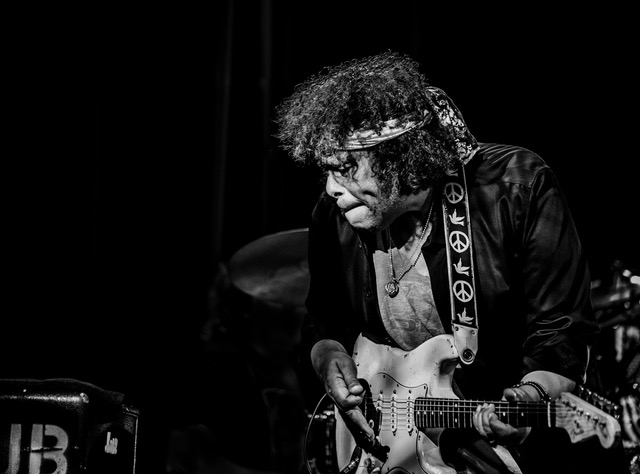
Jon Butcher
The explosive guitar work of Jon Butcher ripped through the airwaves when he arrived on the music scene. And his heavy hitting vocals tied to his hard driving melodies offered, and still offer his fans a full force musical gale to get them pumped and rockin’.
Early on in the ’70s, Jon toured with Johanna Wild, then later hit the road again, accompanying the J. Geils Band’s Freeze Frame Tour At the time, the buzz focused on the Stratocaster playing Butcher as a musician with the guitar licks and flare of the late Jimi Hendrix, although Jon didn’t embrace the notion, but he did pay homage to Jimi, by naming his group, Jon Butcher Axis. The group became the opening act for KISS and Jon’s star continued to rise.
Jon’s group picked up an international record deal with the Polygram label and worked with producer-engineer, Pat Moran who worked with other top acts, including: Rush, Iggy Pop, Queen, Robert Plan, Big Country and Edie Brickell and the New Bohemians.
In 1982, Jon Butcher Axis released its self-titled debut album, that featured the track, “Life Takes A Life,” and the album reached Billboard’s 91 spot for pop albums. And Jon’s Life Takes A Life music video caught the attention of MTV, a success that was a bit of a coup when few Black artists were able to get such traction, other than very few like, Prince, Tina Turner and Michael Jackson.
Having signed with Capitol Records in the early ’80s, the Jon Butcher Axis crew released its album, Along The Axis, nailed down Grammy nominations (Best Rock Instrumental Performance) for the instrumental track, “Rituals”. Other songs gathered well-deserved attention and one, “The Sounds of Your Voice,” hit the Billboard chart reaching the 94 slot, that led to the band being invited on tour with INXS.
During the late ’80s, Jon released two albums, Wishes (1987) and Pictures from the Front (1989), and cuts from the albums were highlighted on the popular MTV show; “Holy War”, “Goodbye Saving Grace” and “Wishes”.
During the ’90s Jon began to work in the multi-media field, as well as continued to compose and record his music, most notably starting a new group, Barefoot Servants, working with the legendary bassist, Leland Sklar. Butcher continued to be a prolific songwriter-producer, releasing a number of albums during the ’90s and developing expertise as a multi-media/video aficionado. By 2004, he was ready to release his first DVD, Live at the Casbah, a compilation of video from one of his concerts, as well as several songs from his earlier career.
More recently, Jon established his company, Electric Factory Music, where he works on a variety of projects for other musicians and artists, as well as has ventured into the synch arena, music production, film/television work and computer gaming. His work includes developing music for such well-known projects as HBO’S Deadwood series, Star Trek: The Next Generation, My Name is Earl, Hendrix: The Movie and more.
Guitar International caught up with Jon to talk about his multi-faceted career and entrepreneurism, perspectives and lessons learned he’s gathered along the way, his current projects including his recent release, Nuthin’ but SOU, and of course, his select choice of guitars and gear. We are pleased to present to our readers, one of the hardest working and most creative musicians around.
******
Rick Landers: Your work ethic looks to be pretty formidable, not so much that you’ve got your hands in so many pots, but the work you’ve chosen is labor intensive; composing music, developing videos for yourself and others, recording and production, and performing. Although, the work looks like fun, there’s also the tedious administrative and managerial side. What are the most challenging aspects of your work that demand disciplines that may not be part of your creative calling and how do you drive projects home to completion?
Jon Butcher: That’s a good word, discipline. I’ve met many great players who never had enough discipline to make natural talent into marketable business. It’s probably the left and right sides of the brain in conflict! The truth is, I’ve always had focus – on becoming a better song writer, a better guitarist, a better music producer. I think I get that focus from my Mom, the career drive and craft focus.

Jon Butcher
Rick: I see you’ve recorded 21 albums, with over 230 tracks. What were some of the toughest lessons to learn in the area of engineering and production, as well as keeping up with technological changes along the way?
Jon Butcher: Learning how to produce myself was and is an ongoing process that requires insight and a measure of self-reflection that takes some getting used to. Also, knowing when not to mess something up! On my new album I re-wrote songs sometimes as many as ten times or more. Not because rhyming is hard, but because expressing complex feelings- in simple and digestible ways is a challenge.
Rick: Let’s get to your latest project. Nuthin’ but Soul, as far as how did you select the songs for the album, who’s on board in the studio with you and what did they bring above and beyond their talents that helped you enjoy the process involved?
Jon Butcher: I recorded most of Nuthin’ but SOUL by myself, in my own home studio before taking the tracks to Bang-s-Song in Gloucester Massachusetts, my home town.
I have a profound creative relationship with my engineer of the last decade, Warren Babson. We’ve formed a creative partnership which has created at least, at least six albums. But I record all the tracks- guitars, vocals, keys, bass, drums and more alone in my basement.
This record also features some great guest vocalists in Chris Pierce (L.A. singer/ songwriter ), Debby Holiday, Rene Dupuis all contributed their wonderful voices. I also had Danny Borgers and Sandy MacDonald contribute piano and B3 (Hammond Organ) on a couple of songs.
Rick: Did you stick with the Strat on the cover or grab other instruments for Nuthin’ but Soul?
Jon Butcher: That ’63 Fender Stratocaster affectionately named ‘The Fat Man’ has been with me a long time, it’s been used on all of my records since the ’90s. I also use several others; a 1953 Fender Telecaster ‘black guard’, a 2018 Gibson ES-335 and an Epiphone ES-355, a ’63 Fender Precision bass and my fav acoustic guitar, a Martin D-28.
Rick: For newbies to your music, do you have a recommendation of one of your albums you think would prove to be a good introduction to your music?
Jon Butcher: For anyone stumbling across me I’d immediately suggest Nuthin’ but SOUL as an introduction and then works backwards from there, to Barefoot Servants with Lee Sklar and then to Holy War and Life Takes a Life by my first band, the Jon Butcher Axis.
Rick: Early on a few folks were comparing you to Jimi Hendrix. I’d imagine that it was important to get attention, but did that kind of hype distract from your own creative intentions or did you just ride it for what it was worth, then move to define your own work about your own style(s)?
Jon Butcher: Yes. At first you want to diminish comparisons, especially when they seem so lazy and unthought out. Then you get to a place where you realize there’s no point in trying to reshape someone else’s impressions. You just do what you do and hope that’ll eventually connect with someone, then one day you realize that you found your own authentic voice.
Rick: Many of our readers are musicians who are at various stages of their career ambitions, and I’d think you may be able to categorize your own career in stages and pivotal moments from playing open mics to paid gigs, then other stages of success and set-backs? What might those be and how do you handle success, as well as set-backs?
Jon Butcher: It’s just life. If you’re a bricklayer or train conductor or musician, there’s going to be some disappointment. Maybe a lot of disappointment. That comes with being alive. It’s the dues we pay to be able to wake up, see the Sun and smell the air. Some of us may develop cancer or heart disease or other health challenges during the journey. The key is to just keep on keepin’ on, as my brother Chris Pierce says. Keep your compass pointed North, toward the music. Failure and success are flip sides of the same coin. In my opinion failure is a much better teacher.
Rick: Has your choice of guitars evolved over time and have you settled on a “go to” guitar while at home practicing, as opposed to studio work? And, what about effects, any favorites or new ones that you’re now experimenting with?
Jon Butcher: When I was a kid I thought the Fender Stratocaster in it’s factory form was pure genius. Then I got distracted by the ’80s, playing Strat-types with hot humbucker bridge pickups, Floyd Rose trem for super gain, overly processed guitar sounds. At the time I thought that and a couple of Marshall JCM-800’s made for a pretty awesome noise. Which it did.
Then one day on a tour bus I saw Stevie Ray Vaughan’s Live at El Mocambo video tape. It blew me away, not just his playing, but his tone. And I remembered all the things a good Strat and amp platform could do. Gear-wise it brought me back to more traditional guitar tones, pedals, etcetera.
(EDITOR: Jon was kind enough to send me a complete list of his gear, below.)
GUITARS
’63 OLY WHITE STRATOCASTER
’63 FCS SUNBURST STRATOCASTER
’53 TELECASTER w/ a newer neck
’63 GIBSON CS ES-335
EPIPHONE INSPIRED BY GIBSON ES-355
GIBSON CS ’58 LES PAUL
MARTIN D25 1935 model
FENDER ’63 P-BASS
AMPS
MARSHALL 100 PLEXI w/ Marshall 2X12 CAB
FENDER ’63 PRINCETON
FENDER VIBROLUX
’90s FENDER ’59 BASSMAN
FENDER TONE MASTER PRO
PEDALS
’60s VOX 848 CLYDE WAH
2010 TEESE RMC3 WAH
2012 LANDGRAF DYNAMIC OD
THE ‘UNKNOWN FUZZ’ SILICON FUZZ, no idea who made it
KING TONE miniFUZZ
CHASE TONE SECRET PRE AMP
STRYMON EC-1
R WEAVER FX MIDNIGHT VIBE
Rick: Did you grow up in a family that supported your music ambitions or did you find you had to fight against a tide of traditional expectations to “find a real job” to survive or thrive?
Jon Butcher: My mother saw something in me and supported it, I think my Dad’s thought I was losing my mind. That was all through high school, then I chose Boston almost on a whim as a place to go to college, to ‘have something to fall back on.’ One day I announced to my parents visiting my Boston dorm room that I was leaving school to become a professional musician. This was not met well by Bill Butcher. Several blows landed, Mom trying to pull him off and the rest of my college career pretty much ended there. But, it was the beginning of my Boston adventure…which led to everything.
Rick: Were you surprised to be nominated for the New England Hall of Fame and/or the Grammy nomination?
Jon Butcher: I think I was just grateful for being recognized.
Rick: I see you have a video production side of your “brand”. What video services do you offer and do you target various budget interests of clients? For example, straight lyric videos versus videos with story lines demanding more complexity and higher pricing?
Jon Butcher: My company Electric Factory Music was born out of a tv show commercial I was hired to provide music for in the early ’90s. That show was The Simpsons and the commercial was seen by millions. Since that beginning we’ve provided music for a litany of Network and Cable programming, from Ugly Betty for ABC to Star Trek for FOX. In recent years our focus is on making video for budget conscious clients who understand how important it is to visualize your message. These don’t have a proscribed script and I think more can be accomplished than just lyric videos for those on a budget.
Rick: Early on were you hoping for or chasing labels or did you have more interest in having your own company, to develop multiple revenue streams? And, is there any need to keep your identity as a creative versus a businessman separately or is this dicing your personal interests up unnecessarily?
Jon Butcher: Early on we were desperate to get on a major label, like all of my musical colleagues were at that time. To us that was how we’d ‘make it’, the door through which all hopeful rock stars passed. Nowadays that right of passage is mostly gone. The Internet, from the perspective of releasing, distributing and monetizing music is both the good news and the bad news.
We’ve all learned that simply posting your new song at your website means almost nothing without a plan to bring vast numbers of people to your website. I don’t think I consciously identify as a creative, I feel like I am one and make no separation from a public perspective. This of course doesn’t negate being ready and equipped to do the business at hand.

Jon Butcher
Rick: Where are you generally happiest, studio, stage, or at home noodling to get some creative traction?
Jon Butcher: Yes!
Rick: After writing, doing the studio work and you’re ready to package an album, I’m finding it hard to come up with an album cover design. What process or feel do you go by to nail down the cover art and format of your albums?
Jon Butcher: It might be different for others, but I find marketing myself, in other words my visual image to be the best avenue for getting my message out. I’ve chosen to be on the cover for many of my albums so music seekers know immediately what and who they’re looking at. There are certainly iconic artists who’ve chosen different images for their album covers, Led Zeppelin comes to mind. But, those Led Zeppelin album covers were created in a time where the artistic pallet was the size of an LP. These days this is often not the case.
Rick: Have you ever had a need to find a session player from afar, like from the FIVERR site? Is it important to actually know the session players personally?
Jon Butcher: I think it helps to have close relationships with those you work with, particularly on the road and in the studio. Those environments can be tough physically and psychologically. I don’t think I’ve ever hired a stranger or solicited someone online for a project I was working on. It’s always among my list of colleagues and friends.
Rick: When tough or awkward decisions need to be made, what have been some of your toughest ones and the outcomes, especially when it comes to relationships with others?
Jon Butcher: There’s a musician in the Boston area who I’ve known personally for many years, worked with that person on records and generally had a positive and rewarding relationship with until recently. That relationship appears to now be on hold and I’m not exactly sure why. I think these things happen sometimes and I don’t think there is a good way to avoid awkwardness. No one likes it, we all struggle with trying to find balance in our relationships, but sometimes *#&# happens”. How to successfully navigate that ? I honestly don’t know the answer.
Rick: I saw you were once looking for someone to draw stick figures for a project. A few weeks ago I suggested to one member of my songwriter circle to watch Nick Drake’s “The Shed” video, so the guy could develop an inexpensive yet effective video. I’ve also suggested Elliott Smith’s bathroom video for “Between the Bars” with over 10 million views, as a way to focus on the song first – What was the result of your stick figure idea and where do you get your ideas for various kinds of videos?

Jon Butcher
Jon Butcher: Great question! Before I started Nuthin’ but SOUL I had a record completed and in the can ready for release. That album was called Electric HollowHead, a character I dreamed up to describe how I was feeling at that time in 2022-23.
I began to develop some artistic ideas to represent that character. Anyway the Electric Hollowed album was mixed, mastered and ready to send to replication… and then I pulled the plug. I’d spent dozens of hours writing, recording, re-recording and on and on. But it wasn’t right. It wasn’t the message I was prepared to underwrite and promote. So, just as I was looking at stick figure drawings to represent the character I was realizing it was time to start over.
Jon Butcher
Rick: What can people expect from your live shows? And do you ever offer unplugged shows where you rely solely on an acoustic guitar?
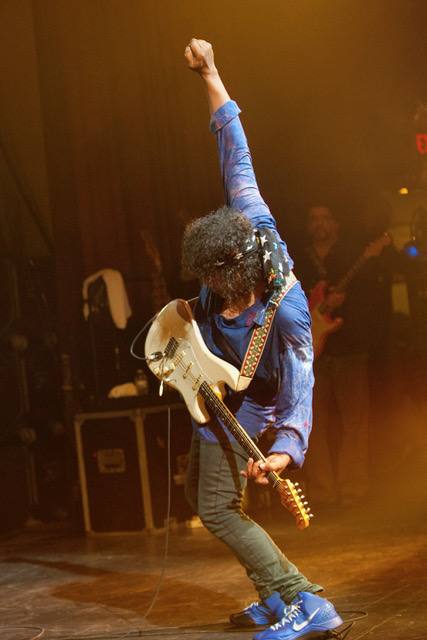
Jon Butcher: In my opinion my electric shows speak for themselves, meaning I think we present a very engaging and dramatic live electric show. I also do a number of acoustic shows a year and I really think that’s where I shine best these days. There’s something truthful in an acoustic performance. There’s a connection that can be made that can be deeply personal. I’d like to do more acoustic shows a year.
Rick: With the release of Nuthin’ but Soul, knowing artists tend to have many ideas or projects in the fire, what’s next for you and do you have many more projects you’ve been planning, but finding it challenging to begin?
Jon Butcher: I’m going to promote Nuthin’ but SOUL until the wheels fall off the wagon for the foreseeable future! Recently I recorded a version of, “All Along The Watchtower,” which turned out really well, but I’m not sure what I’ll do with it yet. I’m hoping and encouraging all Indie film makers reading this to reach out to me. I love the relationship of film and music and have always been interested in expanding those lines of collaboration. Film makers hit me up!
BONUS VIDEO!