by Rick Landers
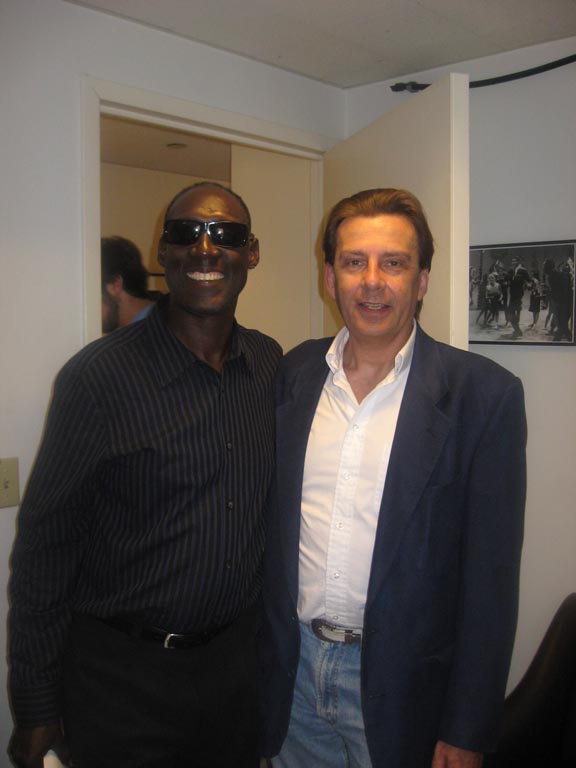
Pepe Willie (left) and George Dassinger - Photo courtesy GDC, LLC.
The world of music entertainment tends to center on celebrities, those who have the musical or other talents that attract crowds and make them roar. Behind the scenes, there are scores of music industry people who “make things happen”. They’re the movers and shakers who can help make or break a celebrity’s career. They like being in the background, they appreciate great talent and they get their kicks from watching others succeed and from being a part of that success.
George Dassinger is one of those movers and shakers. George has been managing his publicity firm, George Dassinger Creative, for over fifteen years and has worked with major clients including: ZZ ToP, Liv Tyler, Patty Loveless, John Prine, Little Anthony and the Imperials, Elliott Rubinson (President, Dean Guitars), along with other clients that range from Fuente Cigars to supermodel Tyra Banks.
Dassinger’s background kicked in during the late ‘70s when he joined the mega-publicity firm, Rogers and Cowan where he ended up in a Vice-President position, where he represented a broad spectrum of top acts including: The Beach Boys; Aerosmith; Van Halen; Wings; the Bee Gees, Paul Williams; Pink Floyd (The Wall); Chicago, boxer Ken Norton and others. One of his publicity “gigs” was promoting the opening of Elvis Presley’s “Graceland” estate to the public.
In 1983, George would move on to work with the highly respected Elektra record label and rose to Vice-President, National Information where he handled major promotional campaigns for Anita Baker; The Cars; Motley Crue; Metallica; Jackson Browne, Simply Red, The Cure; The Doors; Tendy Pendergrass; Linda Ronstadt; Keith Sweat. He also oversaw marketing campaigns for several specialized CD boxed sets.
Today, George heads George Dassinger Creative, LLC, as well as serves as an adjunct professor at William Patterson University where he teaches a self-styled, hands-on course , where his students work real life business projects with such success that Dassinger’s curriculum has been written up in The New York Times, the Herald News; The Record; Montclair Times and local New Jersey news programs.
We spoke with George about the beginnings of his career and some of his experiences in somewhat of a “stream of consciousness” conversation.
******
Rick Landers: Most of us tend to stumble into things, you know, unless we always wanted to be a doctor or a lawyer or that type of thing. I assume that you didn’t grow up thinking, “Oh, I’m gonna be a publicist.”
George Dassinger: No, actually it started with my uncle who lived with us and he was the head bartender at Toot Shores, so in the ’60s he would come home, Rick, and tell me stories about, “Frank was there,” Frank Sinatra, and he goes “and he left us $100 tip.” It was like ’60, ’61. I go, “Wow!”
Then he would tell me, “Steinbrenner was in,” all these people. They all went to Toot Shores: Ted Kennedy, Frank Gifford. It was their place. Yogi Berra, the whole Jackie Gleason. To me that was, “Wow!”. [Both laughing] How cool was that?
And I sort of made up my mind then, “I don’t know how. I’m gonna get somehow into the entertainment business. I don’t want to be on stage. That’s not for me. And I don’t know yet.” I sarted writing…I walk into the college paper, I go to a college here in New Jersey. I walk in the one day and I said, “You know, I have a music column,” and the editor looks at me and goes, “You know, you’re exactly right. Can you get one in by Thursday?” and you talk about stumbling into it. And I went, “Next Thursday?” He goes, “Yeah, next Thursday,” and I went, “Yeah, I can do that.”
I remember going to The Electric Circus that weekend and they were having some kind of PotFest or something with the Holy Rounders, you know, all of that stuff that came out of Easy Rider and I called up and they gave me tickets to get in.
I thought, “Man! This is great!” and I started doing that more and more. I realized if I didn’t have the money to get me into these things, I’m gonna become like a journalist and cover all this stuff, and I got invited to everything and it escalated to the point where I made friends with this company called The War Token Concern. War token which meant, I think, from upper New York state, it’s like that’s what a joint is, a war token. [Both laughing]
And they befriended me. There were three people. They were the stamps that worked for The Filmore East, the guy who did the PR for The Filmore East originally one day just got fed up with the industry, left notes on all their desks, “I’m leaving. You’ll never find me. I’m leaving you the whole company, all my clients. I’m gone. I wish you the best.”
Rick: Wow.
George: Yeah, really. And I got to know them and they introduced me to everybody and they became very, very successful, like representing The Faces and Watkins Glen and just all great clientele and would invite me to everything.
So it struck me, “Ah, this is the way to go.” And because they told me when I went to Warner Bros., go see Bob Merliss. Meet Bob Merliss. And I would meet everybody they told me to meet. And I sort of networked my way, and eventually I graduate college, I’m writing for The Aquarian, which is a New Jersey paper here. I got kind of [ 0:03:58]. I didn’t want to give up my tickets. It got me into Capitol shows.
Rick: Cool.
George: Yeah, in its day. I mean, I got invited to everything. It was just amazing and it continued. I knew I was onto a good thing. Didn’t pay but didn’t matter. I got invited to everything and it continued, so I’m working for the Post Office, writing for The Aquarian and a friend of mine calls me up and says, “Want a job?” and I went, “Well, no I got like life in the Post Office.” And he said, “Look, I need an assistant here. I need somebody that [ 0:04:37], major PR firm of Rogers & Cowan.
Rick: Yeah, yeah. Big one.
George: Yeah, but I had no idea, Rick, at the time what Rogers and Cowan meant. I didn’t know who they were. And I didn’t even bother, it’s not like the day today, I’d Google somebody.
Back in that day I didn’t pay any attention to it. So, I get called into a meeting at the The Regency, with Paul Block and Joe Dera and they tell me that they want to hire me and it’s eight o’clock in the morning and I’m elated.
I realize I could dump the Post Office, finally get into the entertainment business where I wanted to go and I said, “Well, can I order something?” and Paul Block goes, “No.” I said, I’m kind of surprised, and he said, “Well, the guy that we’re firing is gonna be in here in about five minutes and I don’t want you two to run into one another. You have to go but you’re hired.” [Both laughing] There I found myself on the street after calling in sick or something to the Post Office at 8:15 in the morning and real happy that I got this job. I had nobody to tell, nobody to call.
Rick: No cell phones back then and it’s pretty early in the morning, I guess.
George: And I started laughing. I walked down the street, walked my way back to the Port Authority and of course took the bus, the whole nine yards, and I’m thinking this is great. And I still have no idea what I’m really walking into. All I know is that I had done this stuff on the side. How hard could it be?
Then I look at the client roster. I’m looking at all these…they’ve got Hall and Oates, the Bee Gees, and I’m just thinking this is great. Then I started working there and they gave me all the clients that nobody wanted to do anything with and I realized what my role was. [Both laughing]
Rick: You’re clean up.
George: You know, it was all based on money, Rick.
Rick: Oh, okay.
George: Later I got into a bit of a conversation where when I moved from being like manager of the entertainment…music department to Vice President of the Corporate Entertainment PR Department, Henry Rogers wanted me to stop working on some of the clients that had been long-time clients of mine, like Paul Williams.
Rick: Oh, great. He’s a great guy, a great musician and composer.
George: Great guy and great to work with and it was in the whole heyday of when they were doing Smokey and the Bandit. I got to meet Jackie Gleason finally through them. Just great guy absolutely, but he didn’t pay enough.
You know, he wasn’t a corporate client that paid twice, three times what Paul Williams paid, so I finally had to say to Henry, “Look, you don’t care about him. I know you don’t care about him, but you asked me for all these years to develop a relationship with him, work this and now they’re successful and did his TV series and all this kind of stuff. You want me to say ‘I’m not gonna work you anymore?” I can’t do that, Henry. I just can’t.”
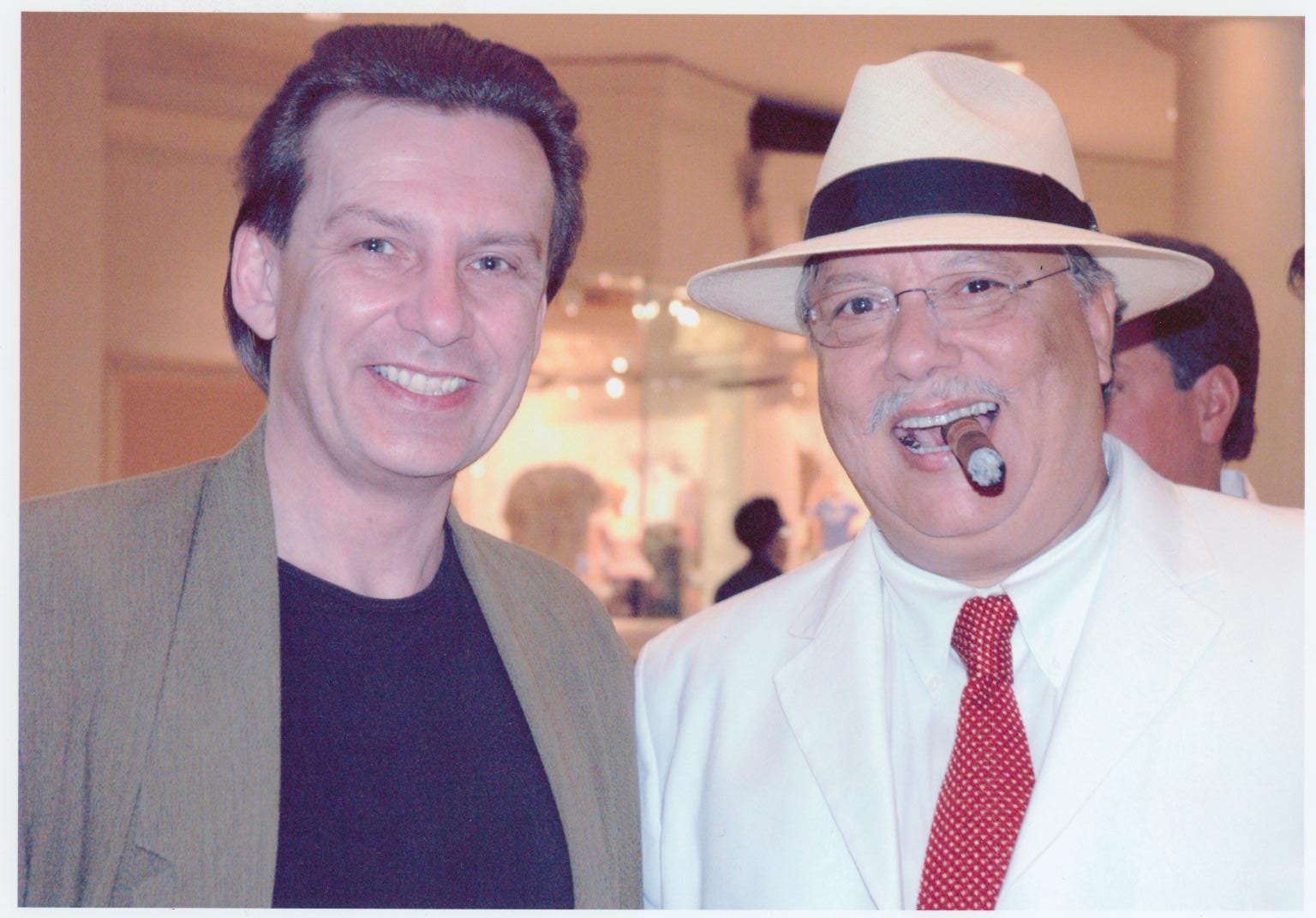
George Dassinger and Arturo Sandoval
And he goes, “You know, George, you’re too much of a mensch.” [Rick laughing] and I went, “You know, Henry, I was raised in a Jewish neighborhood. I know what that means. I’m okay with that,” and he goes, “Well, you’ll never make a lot of money, but I sure wish you were my agent. Let me put it that way. You figure some way to work Paul Williams. I’m dumping it in your lap.” I said, “And it doesn’t matter how I do it, right?” He goes, “No. As long as you pay attention to the clients I care about, we’re good.” So you kind of learn that early on, but it was a great experience being at Rogers and Cowan. I was there for like almost six years. I learned everything, Rick. I learned from the best, I mean, Henry Rogers and Warren Cowan, Cathy Berlin, Paul Block, like I said, Sandy Freeman, Joe Dera certainly. I learned from these guys and I watched how everybody worked and I picked what I liked and kind of ignored what I didn’t like.
Rick: You were very observant then, as far as learning?
George: I was really out of my league. I’m a Jersey kid, all of a sudden I’m working on 54th Street and 5th Avenue and I’m meeting people and in a whole new world that I knew existed but all of a sudden I’m getting invited to things like a dinner at The Waldorf, which I had never even gotten in the door before, unless I strolled through the lobby. [Both laughing]
It was a whole different world and it was great in a lot of ways, I mean, the opportunities it presented me, like to represent the 1982 World’s Fair. I would never, even as an independent now, nobody would ever call me in my office in New Jersey now at my house like you to represent a World’s Fair, but because I was at Rogers and Cowan, they didn’t know what the hell to do with them.
I never had a problem with trying to represent or finding, coming up with a news angle to work my client legitimately, come up with real things they would do. They would say, “Well, don’t we have to lie?” I went, “No! [Both laughing] You don’t think your story’s good enough?”
Rick: Everybody’s got some kind of story to tell.
George: Yes. You know, Rick, sometimes I used to sit there thinking, “Why doesn’t anyone understand this?” and then they gave me all the problem children too, the ones they didn’t want to work. They were paying a lot of money.
They signed a deal, Rogers and Cowan, with Bob Gibson, major power guy in California at the time, and he brought in Van Halen and Aerosmith, a lot of festivals and things like that, and his deal when he signed with them, he had heard about me, which I took as a compliment.
He later told me, “My deal with them, George, was that I get you in New York. They pay me a lot. I rent from them and all, but I get you. Everything I work on, they can’t tell you not to work on it. You have to do this.”
Rick: Cool.
George: And that’s how I wound up getting you in Pink Floyd. Signed Pink Floyd over a poker game, as I understand it, [Both laughing] and when they asked Pink Floyd what they wanted to do, they said they wanted one story. They wanted an interview with Newsweek.
That wasn’t a very hard pitch, believe me, especially when The Wall came out. They did six concerts here which wasn’t hard to do either, as far as public relations, but I would never have those opportunities. They wouldn’t have come my way.
Rick: When did you get Pink Floyd? That was early ’70s?
George: It was during The Wall, when The Wall first came out, they did six nights, three nights in L.A. and three nights at the one coliseum on Long Island.
Rick: Then, that was in the late ’70s.
George: Yeah. Actually no…yes it would have been. Yeah, it would have to be.
Rick: I ate lunch with them once. They were behind me in Abbey Road Studios. Ever heard of Roy Harper?
George: Yes.
Rick: I was working for Virgin Records on a very low scale and only for a few weeks, but I was able to get into Abbey Road and Harper was doing his HQ or what’s also called The Cricketer album, in the States. It’s called something different on each side of the Atlantic. We went down to the galley and one of the guys from Virgin in Coventry nudged me and said, “That’s Pink Floyd behind us!” and they were eating Chinese food and champagne. They were recording some album at the time. This would have been like 1974, ’75.
George: I never met them.
Rick: Oh really?
George: No. My deal was, Bob Gibson called me up and said, “George, they want to do an interview and one interview only and you’re gonna have to get this for them and we’re gonna get paid for six months. That’s all you’ve got to do. And they want to do it over the phone.” So, I knew damn well I’d never get to meet them, but it wasn’t hard to set up. “Hey, do you want to speak to Pink Floyd about The Wall?” [Both laughing]
I said, “This is the one and only interview they’re gonna do.” Same with opening Graceland. I wouldn’t have the opportunity to do that. They sent me down there before it even opened, and by now I’m kind of more New York savvy and stuff. I go down there and I can’t even get a cab to take me from the Howard Johnson’s to Graceland.
They would call up and they would just never show up, so I would walk along the highway finally get to Graceland, they wanted me to look at the museum that they put together, that Priscilla and this guy Jack Soden did. I walked through it, Rick, and as a kid, I remember my parents driving down to Florida with me and we stopped at the Charlie Arquette museum. They used to be down South and they were all, the original Charlie Arquette, the comedian, but they would have these Civil War museums. They were always so rinky dink. They weren’t really…like they tried real hard but they weren’t the Smithsonian.
So, I go in there and I’m looking and some of the mannequins noses are broken off, pieces of ears on others [Rick laughing] and they took all the albums, Elvis’ albums, and they used it as kind of a ‘Follow the Yellow Brick Road’ on the wall so you would follow it through the museum.
So, I get back to New York after being there and they want to know, “Well, what do you think? The estate’s really in financial ruin and we figure by opening as a museum, we’re gonna do old PR and Roger & Cowan as part owners. What do you think?” I say, “We’re in trouble.”
Rick: Yeah, the branding part of it would really hurt you.
George: Yeah. I said, “We’re in trouble. They did what they could and it’s commendable, but it isn’t really quality. It’s not a museum. It is not like walking into the Museum of Natural History and that’s what it’s gotta be.”
I could hear Paul Block panicking, but at that time we had just signed a deal with Morgan Mason, James Mason’s son, who would come out of the Reagan administration and handle that whole mess of a Bloomingdale scandal. Remember he had a young girlfriend that came out…?
Rick: Yeah.
George: Well, he took the brunt of it. He was the guy who had to go, so he gets hired by Rogers and Cowan, and a really nice guy, incredibly nice guy. Gets on the phone and I start telling him about the museum and he says, “I think I could put a call into the Smithsonian. I think I can convince them to go in there on taxpayer’s money, really just do over the museum.”
Rick: Really.
George: I go, “Oh, Morgan. That would be great. If you could pull that off…” Sure enough, they saw Elvis as iconic and the first white artist to blend white music and black music, bridging a whole gap. They sent a hit team in there, Rick, and the way you see Graceland today, they totally renovated it, built a whole wall of albums. They knew what to do. They were incredible.
Obviously what it is today is what they did, kind of a behind-the-scenes story. But, the Smithsonian really rebuilt Elvis’ Graceland. Where else would I have been a part of something like that?
Rick: I don’t know if anybody knows that story.
George: You know, I actually finally did it. For the longest time I didn’t talk about things I did. I just kept working. I didn’t think back. My son would say stuff, he would ask me, we don’t talk much about it. I go, “You want to talk about it? I’ll tell you. The minute I start talking too much about my past clients or something, my days in this business are over.”
Rick: It’s a real sensitive industry.
George: I’ve reached a certain age where I just don’t care now. What are they gonna do to me? I just kind of look at it different and I talk about some. I recently wrote a piece that I saw on Elvis.news about the opening of Graceland. It’s like a two-part thing that they ran back in December because it was Elvis’ anniversary. I thought it was appropriate and I never did anything like this.
They emailed me back and said, “Could you write a two-part?” and I said, “Yeah, I can take you through it day by day.” I mean, it was a great experience to watch it. And I knew exactly what to do. It was the first time I remember handling an event where, not like saying, “Yeah, I know what I’m doing,” and then thinking once I left the meeting, “Oh God! How am I gonna make this thing work?” The minute they called me, I knew exactly what to do.
I said, “We take all the [medians 0:16:57] off that we have coming. Each one gets something different.” Paul Block goes, “George, can you do that?” “Yeah, yeah. We’re talking about Elvis. It’s not gonna be hard. I guarantee you I could call Time magazine right now and they’re gonna buy the idea of Priscilla with Flaming Star, exclusive photo, they get it for their page.” And he goes, “Oh, you do this,” and that’s basically what I did.
I gave everybody something different. Everybody walked away happy instead. I hated walking into those meetings where they would say, “It’s us against them,” meaning the media. I thought, you know, there’s got to be a way we can do this where everybody walks away happy.
Rick: Yeah, leverage each other.
George: Yeah, win-win. Instead they always enjoyed being contentious. I had to stop Joe Dera once from beating up a photographer for Associated Press at a Bee Gees event.
Rick: [Laughing] That’s always a clever thing to do.
George: I go, “Joe, what are you thinking?” He goes, “Do you know what he did?” I go, “It doesn’t matter. We had a benefit for the Bee Gees and you’re gonna beat up a photographer,” and he goes, “Buy me a beer,” so I took him to the bar. [Rick laughing]. He would have killed him, too.
Roger & Cowan were so powerful at that time, Rick. They represented Alan Carr and Robert Stigwood. They just had everybody.
Rick: Wow.
George: They thought, “We’re the best at this. There’s nobody better. Get out of our way and everybody else doesn’t count. We won’t allow them in.” And I made sure that I do what journalists like guys like Bob Crowsweener and Joe Dera would say to me, “Oh, he’s ugly. Why do you work with him?” I said, “What has that got to do with it?” Music journalists…
Rick: Yeah, you’re building relationships.
George: Yeah. I never saw it that way. I just never did. And he goes, “Well, you do it your way. But, if I have anything to say, they’re going.” Eventually that’s why I had to move to another department, just couldn’t take Joe’s…though we had been friends loading trucks together at UPS, by the time now we were professionals, ah…
Rick: Yeah, things change and relationships change.
George: I once said, “What’s your problem with me?” and he said, “Either it was gonna be me or you taking over the New York office,” and he said, “and I just wanted to make sure it was gonna be me.” I said, “You know what, Joe? I never wanted it. I would have turned it down. I don’t want to run that damn office,” and he looked at me, I just saw him recently, just disgust. [Rick laughing] That kind of pregnant pause. But, it was a great learning school and I learned and I kind of came up with the idea of using public relations as marketing, not to just do publicity.
Anybody can do publicity. Just do stuff different. Like one day Pat Newcomb used to have the office next to me and she says, “George, can you come in my office? I want to introduce you to somebody.” I’m thinking, “All right. Who could it be?” friend of hers, associate. I walk in and there’s Warren Beatty sitting there.
And she goes, “Warren, this is George Dassinger. I love the way this guy works and I wanted the two of you to meet.” Warren Beatty, I’m like, God. I was unprepared for this.
Rick: Yeah. [Laughing]
George: So, it’s just a wonderful place to be, but then it reached the point where Henry Rogers said, “Your problem with you and Joe Dera is personal.”
I said, “No it’s not, Henry. If you’re not gonna address it that way, I’ve got to resign.” He goes, “Well, you do what you’ve got to do.” So I resigned and I went to another PR firm for about a year and I started working representing Teddy Pendergrass.
Rick: What year was that? ’80s?
George: Late ’80s. Yeah. Actually, early ’80s. Let’s see, ’82 perhaps, ’81. Somewhere right around in there. I’m at the PR firm, and I do this really great job on Teddy Pendergrass and it was after the accident and so forth.
Bryn Brinethall was the PR, head of PR at Elektra. I worked with her a lot. After months of Teddy Pendergrass she calls me up one day and says, “You want a job?” I said, “I already have one.” She said, “I want you to take my job. You’re not gonna get as much money, but you always told me you would love to be at a label one day. I’m giving you that opportunity. I’m going back to California. I’m gone. I think I can sell them on you,” and I said, “Yeah.”
It was something I had always wanted to do, because I’d always been weird. For example, when I represented Aerosmith we were hired by Columbia to represent Aerosmith, so whatever we did, Columbia really was the client. Aerosmith was the one they couldn’t handle.
Rick: Couldn’t handle the band?
George: In the days when they were doing heroin? Oh, absolutely.
Rick: Oh, yeah. [laughing]
George: That’s another one of those stories where I got in trouble thinking I did a really good thing. I finally convinced Steven Tyler and Carol Kaye was working in his management company. It was Lieber Krebs at the time and I get a call saying, “George, can you come to The Plaza on Sunday? Steven Tyler’s in town and we want you to set up this Associated Press interview with Mary Campbell,” and I went, “Mary’s been waiting for this.” So I set it up and you’re supposed to arrive sort of like 2:00 or something.
So, I’m there early and go in his suite and Steven’s going, “I don’t know if I want to do this interview.” I said, “Steven, you can’t cancel like two hours before. You can’t do this.” He said, “I can do anything I want to do.”
And I went, “All right. Cancel it.” Carol Kaye looks at me with this look. I said, “Just cancel it. Who cares? Let’s just blow everything off. The fact that maybe this would appear in like a thousand newspapers and hundreds of thousands of people probably would have read about you for the first time. Steven talking outside of the band. Hell with it. Let’s just chuck it all off. Who cares?” [Rick laughs] He looks at me and he says, “Oh. I’ll tell you what. I’ll do the best interview I’ve ever done. How’s that?” [Both laughing]
And I said, “Steven, if that’s what you want to do. You want to do the best interview, great. You want to blow it off? I don’t care anymore. My job’s to get it for you. You want to blow this off, it doesn’t make any sense to me. Carol and I put a lot of time to make this happen and you want to blow it off, just blow it off.”
He said, “If you say ‘blow it off’ one more time, I will. Right now I’m doing this,” and, Rick, he swept Mary Campbell off her feet. Ordered food for her, got her chair. He was incredible. She walked out of there, she was a really big woman, about six foot something, the nicest person. She wasn’t even walking on the carpet any more by the time she left. I was closing the door and he looks at me and he goes, “Am I good?” I said, “You’re the best. You’re the best I’ve ever seen.” [Both laughing]
“She walked out of here on a cloud. This will probably be an incredible piece she does. You were just amazing.” He said, “You know, she was really nice. I kind of enjoyed it. Thanks to both of you. I’m sorry if I gave you a hard time.”
All right, you’re gone. Next day, let’s see, it was a Sunday, like I said. Monday I go into the office. I’m real happy I pulled this thing off. I’m ecstatic, Rick. So I call up Columbia, like I said, they were the client. Susan Blonde ran the PR department. I call her up. I don’t know if you ever knew Susan or talked to her.
Rick: No, no.
George: She has her own PR firm and she’s famous for being in an Andy Warhol movie where she threw the baby out the window. [Both laughing] And she really thought who she is and still does, hates my guts to this day.
So, I call her up and I go, “Susan, how did this whole thing happen?” and she used to talk like…[accent] “Well, how the fuck did you get this to happen when my fucking staff can’t?” and I’m going, “Ugh.”
Rick: Oh, great.
George: I said, “So, you’re pissed off that I made this thing happen.” She goes, “I’m pissed off because you made it happen and my staff couldn’t, so if you’re asking me if I’m happy. Fuck you,” and hangs up on me.
I thought, “Boy, I’m learning a real important lesson here today.” [Both laughing] It’s one of the greatest things I’ve done since I’ve been working and I just got a “Fuck you,” from the client.
Rick: That’s amazing. [Both laughing]
George: And today, even today we avoid crossing paths because I thought, she’s the only person I ever tolerated talking to me that way, first of all. And it was not, like I said, the experience of how I pulled this off, I got them to do it and then to get that…
Rick: The balloon deflates.
George: And I learned there’s sibling jealousy and it’s pervasive.
Rick: Yeah, yeah.
George: By the time I was at Elektra, now I’m in a whole different position. I get this big office overlooking St. Patrick’s. In the building with Atlantic Records, Warner Bros. I could not have been there at a better time, but then I find out the label is the bottom of all the record labels in the entire industry. Elektra’s at the very, very bottom. We’re nothing. No budgets. No money.
Rick: That’s amazing because given their history and their legacy: they were getting all the good people in the ’60s and early ’70s.
George: Yeah, and then they bottomed out, for whatever the reason. They brought in Bob Krasnow who was originally the A&R guy at Warner Bros. who signed Jimi Hendrix, notorious, still alive actually, but legendary in the industry, just like Bob Merliss used to say, “Everybody’s got a Kras story.” [Rick laughing] He would lace brownies and have a marketing meeting at Warner Bros. While everybody was like melting out of their chairs, proceed to give a three-hour marketing meeting. Back in the day, you know?
Rick: Yeah, yeah.
 George: And I had heard all these stories and he’s the head of Elektra and a lot of the people had been with Warner Bros., so they knew him. Everybody knew him. I’m new to this, that end of the business, coming into a record company, and the way it had been run before is pretty much was an office where they would hire out. They would outsource and then they could call up the PR firm, “Well, haven’t you got anything yet?” and push them around.
Nothing ever got done. But, I didn’t have to do that. I knew how to do that. Let’s see, I had one person working for me and an intern who was Tom Courting. Tom Courting is now over at Sony, vice president of Sony. And Sandy Swaka who’s over at the Brooklyn Academy of Music.
I remember being in there one day and Sandy comes in and she says, “You know, it’s different working with you.” I said, “Why? Because I’m a guy?” and she goes, “Well, Bryn was a bitch on wheels and you’re anything but.” I said, “By the way, Sandy. What’s bothering you today?” She says, “I have my period.” So I said, “Then what are you doing here?” She says, “What? Bryn…you have to come in.” I said, “Bryn’s not here anymore. I want you to pack up your things and go home. I don’t want you here for 80%, headachey. I don’t want you here like this. I want you 100%.” She looked at me, she said, and today we’re still best friends, “Oh, you’re so great to work with. This is terrific.” I just saw it different, you know?
Rick: Yeah.
George: I thought, I’m running the department. I can do anything I want.
Rick: Sure, uh huh.
George: So, first I go to Elektra. Like I said, they’re out of money. They’re putting out all these reissues that they were remastering which was a complete bogus thing. They put these records…just repackaged them, that’s all they did, and they made money. It actually started to bolster money. Then they started to sign acts like Simply Red, Anita Baker. Krasnow signed The Cure, Motley Crue came on board.
Rick: Some money makers.
George: Dokken, all the success they had. Metallica.
Rick: Oh, really?
George: So I did all of those campaigns and they were fun. I had a lot of fun. I knew about Jackson Browne, a lot of his stuff. I remember calling up Jackson and he says, he was doing Lives in the Balance, was being released.
Rick: Yeah, good album.
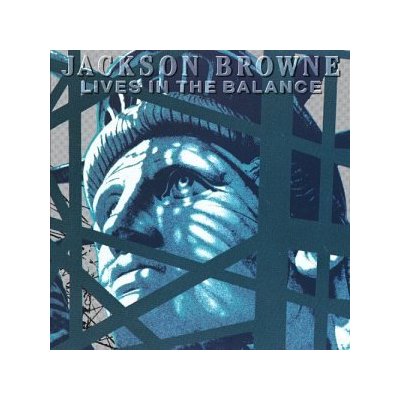 George: Yeah, great album. I said, “You know, Jackson.” He goes, “Well, I know you’ve probably got some sort of marketing plan,” and all this and I went, “No. This is a personal testament. I’m really gonna release this record with a letter from you, no Elektra identity at all. Nothing. Absolutely none.” and he goes, “Are you kidding me? How are you able to do that?” “I already got the approval. They don’t care about this record, Jackson. They know there’s not a hit here the way they see radio. They don’t care. They’re letting me do whatever I want to do. I want to put out the record with just a letter from you.”
So, [Buter 0:31:03] Miller was his manager at the time and he goes, “Did you just tell Jackson this?” and I went, “Yeah. That’s the marketing plan. This is Jackson’s record. That’s how it’s gonna be released. I already got approval. All he’s got to do is write the letter.”
And he goes, “You are great to work with. This is the way his record should be released.” I said, “On top of that, the label doesn’t care about this thing. I’m the only one. I’m the only one you got here, guys. Sorry,” and they went, “No, no. We’re fine with this. Jackson is so happy because he hates the commercial aspect, but you’ve got to be a part of a record company anyway, but you’re helping a lot and this is a very important record.” That’s how we released it and then it became a story unto itself, that a label would do such a thing.
My favorite one is, and I shouldn’t laugh. [Rick laughing] I got a call from a radio station in Cleveland and I’m thinking, “What are you calling me for?” I think it’s a radio promotion, but I take it anyway. They tell me that they have a report of an Arab kid who is beaten up in a suburb and the station had been playing Killing an Arab by The Cure, and that the song provoked this.
I said, “That song’s ten years old,” and the guy went, “Oh. Well we wanted to bring it to your attention. It’s gonna break in the news and we just thought since we looked it up and found The Cure is signed with Elektra Records and we thought you should know,” and I go, “Oh, right.” So I go into Bob Krasnow’s office and I tell him about this and he goes, “This is not good, George. That’s not good at all,” and so he calls up Chris Perry who is the manager for The Cure and then Chris Perry calls me and then the lawyers are calling and I’m going, “Oh, I know where this is gonna go.”
Days and days of conversation and I call up Chris Perry and I say, “Look, Chris. I know you’re coming in here. I know you’re supposed to meet with the Warner Bros. lawyers and the label people and radio promotion,” and he goes, “George, I want you there, too.” I said, “I’ll be there, Chris, but here’s how it’s gonna play out. They’re gonna ask you to postpone this for awhile. Let’s investigate. Let’s look at it for the next 30 to 90 days and see where it goes. I guarantee you they’re gonna just put it on a back burner and just hope it goes away with time, instead of being proactive about it. This kid got his ass kicked and they’re blaming a song.”
He says, “Well, George, I’m tipping you off, Robert Smith’s gonna call you.” Robert Smith of The Cure.
Rick: Oh, okay.
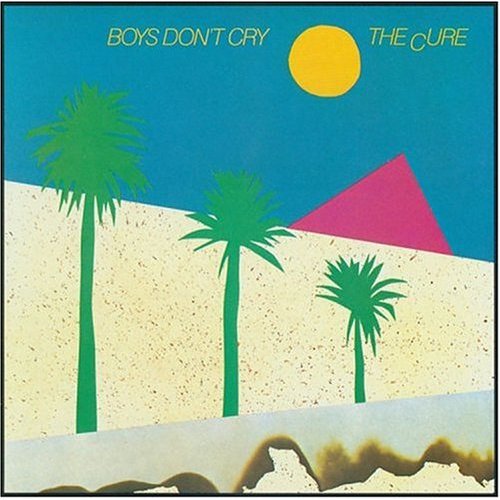
The Cure's "Boys Don't Cry" on Elektra Records.
George: So, Robert Smith calls me and he’s very British obviously, and he goes, “Don’t they understand this is a song that was based on Camus?” [Both laughing] I said, “Robert, you have to understand this is America. They don’t know the difference between Camus and Camaro. They don’t know. Granted, I understand. I know the story too. Guy’s walking along the beach and just kills a stranger. I perfectly understand where it’s derived from. The average person doesn’t have that kind of education on this.”
Rick: Yeah, people don’t read about existentialism. [Laughing]
George: So I said, “Why don’t you just write a personal letter saying that you detest that somebody even thought to even use one of your songs as an excuse for violence?” To make a very long story short, it got picked up. The radio station’s played it. Robert Smith takes a stand against this kind of beating and then I get a call from an American Arabian group or Arab American group out of Washington, a guy named Faris Bouhafa, who tells me that he’s heard all of this and that they were gonna start a protest. But, because Elektra’s taken such a stance, the band has taken such a stance, they want to reward them with an award for what they did, for standing up against this kind of violence, racism, etc.
Rick: Oh, wow. Complete turnaround.
George: I call Chris Perry in London, tell him, “Chris, you know, now they want to give the band an award just because they took a stand here. You backed up. If we put this on a back burner, it wasn’t gonna go away. Now we’re on the better side of this whole thing.” It was one of those things again, too, I knew exactly what to do. And I remember Bob Krasnow pulled me aside one day and he said, “Why’d you do all that?” I said, “Because it was the way to make it work. It also sold a lot of records. A ten-year old record of greatest hits collection just went gold and it’s on its way to platinum.”
Rick: This was before downloads too, right?
George: Yes. Oh, yeah. This was hardcore records. Real records.
Rick: Yeah, yeah.
George: And it was. Once again, kind of did the whole thing, didn’t have radio support or anything. It was anti-radio. Even Metallica, when Metallica first joined Elektra with Ride the Lightning, which was their first release, there was only one radio station playing that kind of music. That was in Los Angeles, San Francisco.
I got them on MTV based on a pitch that they had a t-shirt collection. It had nothing to do with their music, but I knew how to make news. I knew what news angles were, so it was easy for me when I saw a client and everybody didn’t know what else to do, I could figure something. I knew where to go right away.
Same story, I get called into the black vice president of Elektra and he says, “Who you gonna hire to do all the black music?” I said, “Nobody.” He goes, “Nobody? Bryn had a whole PR firm doing it.” I said, “I’m gonna do it.” He goes, “Well, what do you know about black music?” [Both laughing] I said, “I was raised in Jersey City. I actually know a lot about black music. In fact, I like black music more than I like white music if we’re gonna break it down.”
He says, “All right, wise guy.” He tosses me a cassette and says, “It’s unlabeled. Go home, listen to this over the weekend and then Monday I want you to walk in here and tell me what your marketing plan’s gonna be.”
I said, “Okay.” I put it in my pocket. I go home. It’s the first Anita Baker record, first produced by George Duke, just blew me away. God, this woman could sing paint off the wall. So, I walk in there and go in to Greg Peck. He says, “Where’s the marketing plan?” I said, “I don’t have one. I’m not gonna give it a marketing plan. All we do is put her on the cover of Jet magazine. That’s the first thing we do.” And he looks at me and goes, “Wow, you do know what you’re doing, don’t you?” I go, “Uh huh.” We became best of friends after that.
Rick: You knew the market.
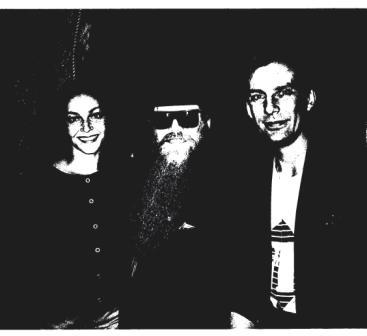
Dusty Hill (Center) of ZZ Top with Isabel and George Dassinger - Photo courtesy of GDC, LLC
George: Yeah, I just knew where to go and how to take it and also work celebrity. Like to me, I didn’t listen to the first Metallica record at all. Tom Courting used to say, “George, how can you work something you didn’t listen to?” I said, “I worked them as celebrities. I didn’t need to listen to the music. They don’t care what I think of their music. What do you want me to do, lie? I may not like this and I’m not gonna get us on a lie to somebody about something. I’m gonna find something that works, something that I think, a hook that they’ll just catch on and maybe get some media attention. Once they get a foothold, we can work this.
Rick: So you really have the experience and maybe even the personality or character traits to not stick with your own little paradigm, but you have no qualms diversifying what you look at as, anything that can market that makes sense, you don’t discount or write off.
George: I think you have to find an angle that makes it work and a lot of this stuff came from Henry Rogers, being around Henry Rogers. He would tell me such great stories about things that he did in the early days, like I said, “How’d you ever get Rita Hayworth on the cover of Life magazine?” and he goes, “I sent them photos.” “That’s it, Henry? I love that.” He said, “And the photos are great shots and that’s how she got on the cover of Life magazine. Had I not sent them, it wouldn’t have happened.” I said, “I love that.”
And then I once asked him about John DeLorean, I said, “Look, we represent John DeLorean here, but we don’t ever do anything for John DeLorean. I also don’t understand how come General Motors is funding his company? It’s a competitor, right?” and he says, “George, you don’t know what happened? General Motors caught John DeLorean stealing money as the vice president and to avoid the embarrassment, they gave him his own companies and financed him.” “I love that, Henry.” [Both laughing] “Only in America could that happen.”
Or once I remember asking him about, we had Charlie Bronson on us. I asked, “Do we ever do anything for Charlie?” He goes, “Yes, we do.” I said, “What do we do for Charlie Bronson?” He said, “To everybody that calls, any request we get, we say, ‘No.’ That’s what Charlie hires us to do.” [Both laughing]
I said, “And he pays you $2,500 a month just to say no?” “We’re the bad guys and then Charlie gets to say, ‘Oh, my press agent didn’t suggest that I do it,’ and he’s okay with that.” But, that’s great.
******